

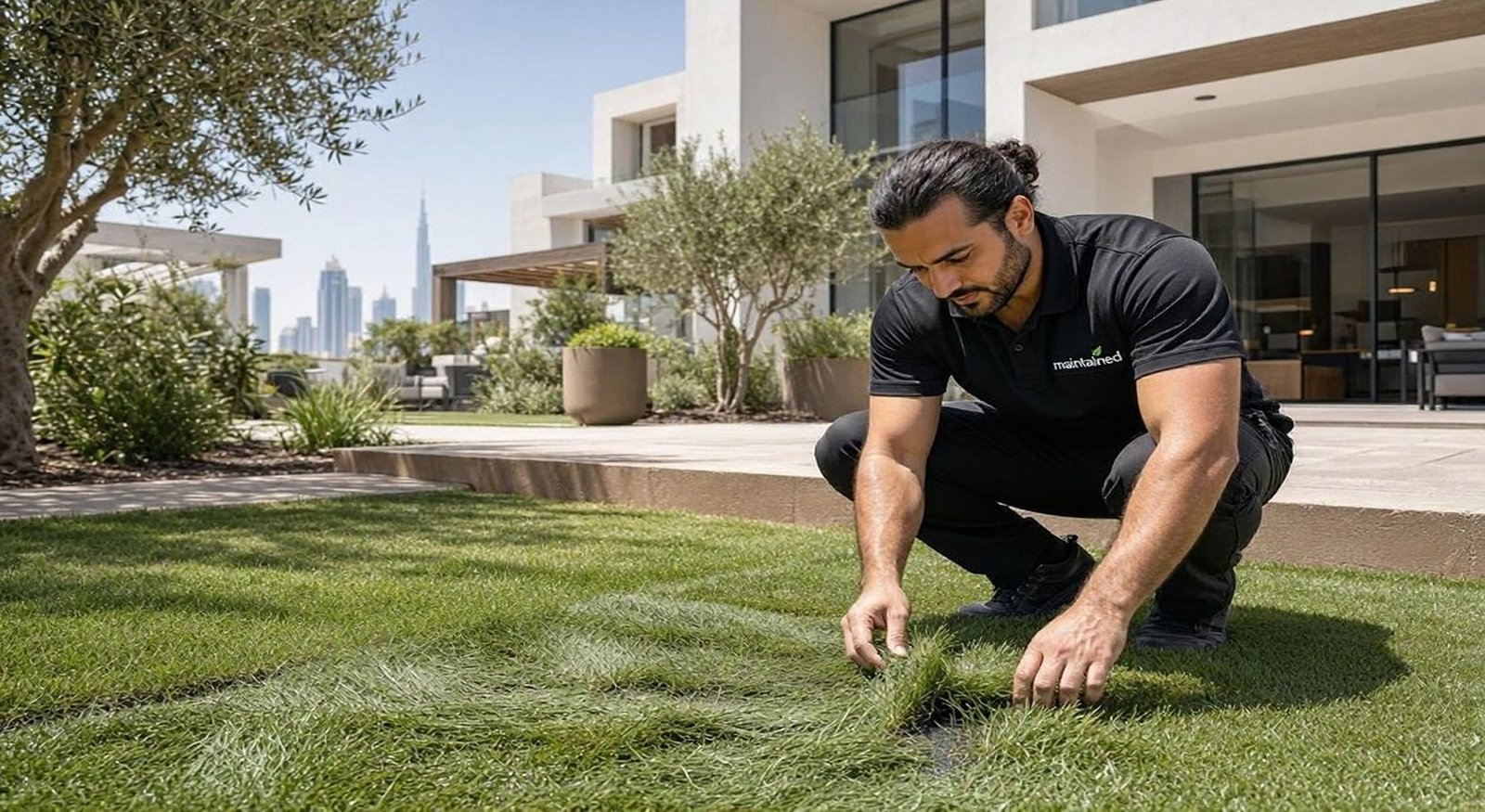
Every villa owner in Dubai reaches the same crossroads eventually. The lawn looks tired, the water bill is higher than it should be, and someone suggests artificial grass as the obvious answer. It seems simpler — no mowing, no sprinklers, no yellow patches. Then you touch a friend’s fake lawn in August and realise it’s hot enough to burn a bare foot.
Neither option is straightforward in this climate. Natural grass in Dubai can look superb — but only if you pick the right species and water it properly. Artificial grass is low-maintenance, but the cheap stuff fails in the heat within two summers. This guide sets out what actually matters when you’re choosing between the two, without the sales pitch from either side.
Why Grass Struggles in Dubai More Than Anywhere Else
Three things make a Dubai lawn harder to grow than the same lawn in Europe or even neighbouring Oman.
The heat is the obvious one. Surface temperatures on exposed turf can exceed 55°C in summer, and most cool-season grasses simply shut down. They don’t die, but they stop growing, go brown, and take months to recover when temperatures drop.
Water is the second issue. A natural lawn in Dubai needs irrigation most days in summer, and if the water comes from a tank rather than the mains, the quality matters — high salinity builds up in the soil and slowly poisons the root zone. Our water tank cleaning team often finds that a failing lawn traces back to tank water that hasn’t been tested in years.
The third is soil. Much of Dubai’s ground is sandy and free-draining, which sounds good until you realise it holds almost no nutrients. A lawn planted into unprepared sand will struggle no matter how much you water it.
Best Grass for Dubai: What Actually Survives Here
Not all natural grass is equal in this climate, and the “best grass in Dubai” question has a fairly clear answer.
Bermuda grass
The most common choice for villas across Dubai. It’s heat-tolerant, recovers well from wear, and handles the salinity in recycled irrigation water better than most. It goes dormant and brown in winter, which surprises owners who expect year-round green. The other catch is that Bermuda spreads aggressively — it will creep into flower beds if there’s no edging.
Zoysia grass
Slower-growing than Bermuda, which means less mowing, and it holds its colour slightly longer into winter. It’s a good choice for villas where the lawn is ornamental rather than heavily used. The downside is cost — Zoysia installation in Dubai is typically more expensive than Bermuda, and it takes longer to establish.
Paspalum
The go-to choice for coastal villas, particularly in Jumeirah and along the Saadiyat shoreline, because it tolerates salt far better than Bermuda. If your irrigation water is brackish or your villa is close enough to the sea that salt spray reaches the lawn, Paspalum is the sensible pick. It’s less wear-tolerant than Bermuda, so not ideal for a family with dogs and football-mad children.
For most villas, the realistic shortlist is Bermuda or Paspalum. Zoysia is worth it if you’re after a fine ornamental lawn and don’t mind the extra cost.
Artificial Grass in Dubai: What the Price Buys You
Artificial grass cost in Dubai varies enormously, and the variation is almost always about quality rather than installation.
At the budget end of the artificial grass UAE price range, you’re typically looking at a low-density product with limited UV stabilisation. It’s sold on price per square metre and it looks fine for the first year. In this climate, the cheap stuff fails predictably: the fibres flatten, the colour fades unevenly, and the backing starts to break down under the heat. Two summers is a realistic lifespan.
At the premium end, you get denser fibres, better UV protection, a multi-layer backing and a proper infill. That product lasts six to eight years in Dubai conditions, sometimes longer, and it stays cool enough to walk on comfortably in bare feet for most of the year.
As a rough guide, artificial grass Dubai price per m2 sits in a wide band — from around 35–50 AED at the budget end to 120–180 AED for premium products, before installation. Installation in Dubai typically adds 20–40 AED per square metre, depending on site preparation. For a 50 square metre villa garden, that puts the full project anywhere from about 2,750 AED at the cheap end to over 11,000 AED for a quality installation.
Natural Grass vs Artificial Grass: The Cost Comparison
The upfront cost is where artificial grass wins clearly. The longer-term cost is where the picture changes.
- Installation cost per m² — Natural grass (Bermuda/Paspalum): 25–60 AED. Artificial grass (premium): 140–220 AED
- Water use in summer — Natural grass: high — daily irrigation. Artificial grass: none for the lawn itself
- Yearly maintenance — Natural grass: mowing, fertilising, pest control. Artificial grass: occasional brushing, annual clean
- Lifespan — Natural grass: indefinite with care. Artificial grass: 6–8 years for premium product
- Heat underfoot — Natural grass: cool. Artificial grass: hot in direct summer sun
The cheap artificial grass Dubai market is worth avoiding entirely. If the price per square metre is significantly below the range above, you’re buying something that will need replacing in two years, and the total cost across that period ends up higher than doing it properly once.
Tired lawn or garden you want to rethink?
Contact MAINTAINED to assess what your lawn actually needs before anyone quotes for a replacement.
The Heat Problem With Artificial Grass
This is the issue that catches people out, and it deserves its own section because it’s rarely explained honestly by installers.
Artificial grass heats up in direct sun. Not slightly — surface temperatures of 70°C and above are common on summer afternoons, which is hot enough to cause discomfort through a thin sole and genuinely painful on bare feet. The reasons are straightforward: synthetic fibres don’t evaporate moisture the way real grass does, and the infill absorbs and retains heat.
There are mitigations. A quality product with a lighter colour, a proper silica infill rather than rubber crumb, and some shade during the hottest part of the day all help. But no artificial grass in Dubai stays cool at 2pm in July. If the lawn is somewhere children play barefoot or a dog spends time, that matters.
Natural grass, on the other hand, cools the air around it through transpiration. Standing on a real lawn in summer is noticeably cooler than standing on paving next to it. That’s a genuine advantage in a garden where you actually spend time.
Water Use and Maintenance: The Real Comparison
The usual argument for artificial grass is water saving. It’s true, but it’s only part of the picture.
A natural lawn in Dubai uses a substantial amount of water — typically several hundred litres per week for a medium villa garden in summer. The irrigation system also needs maintaining, and a leaking valve or a failed drip line can waste far more water than the lawn itself uses. Our plumbing team handles irrigation system repairs and leak detection, and a properly functioning system makes a measurable difference to both water use and lawn health.
Artificial grass uses no water for the lawn, but it does need cleaning. Dust settles into the fibres, and after a season it needs a proper wash — a jet wash with the right pressure and nozzle is the standard method, and it needs doing once or twice a year to keep it looking and feeling right. Skip it and the surface becomes gritty and dull.
On maintenance time, artificial grass wins. No mowing, no edging, no weed control in the lawn itself. For a landlord or an owner who isn’t at the property year-round, that’s a real advantage. For someone who enjoys gardening, it removes one of the pleasures.
Artificial Grass for Balconies and Small Spaces
One area where artificial grass is genuinely the better choice is the balcony. A villa balcony or terrace with a small area of grass has always been an awkward proposition — soil depth is limited, irrigation is fiddly, and drainage has to be carefully managed so water doesn’t reach the apartment below.
Artificial grass for balcony Dubai projects is now very common, and it works well. The grass is laid over a drainage mat, the edges are fixed properly, and the result is a usable outdoor space that doesn’t need watering or mowing. If your balcony gets direct afternoon sun, choose a lighter-coloured product — the heat issue is worse in a confined space with no airflow.
Which Should You Choose?
For a family villa with children and pets, natural grass is usually the better answer despite the upkeep. The cooling effect, the wear tolerance of Bermuda, and the simple fact that it feels like a garden rather than a carpet make it worth the water and maintenance.
For a rental property, a holiday home, or a villa where the garden is viewed more than used, premium artificial grass makes sense. The cost is recovered over six to eight years through eliminated water bills and maintenance, and the appearance stays consistent.
For balconies and small terraces, artificial grass is the sensible choice in almost every case.
What we advise against is the middle path: buying cheap artificial grass and expecting it to behave like the premium product, or installing natural grass without addressing the soil and irrigation properly. Both routes end with the same conversation two years later.
If your villa has an existing lawn that’s struggling, the first step is diagnosis rather than replacement. Sometimes the answer is a different grass species, a repaired irrigation line, or a soil improvement — much cheaper than tearing it all out. Our landscaping team can assess what’s actually wrong before anyone starts quoting for a new lawn.
Get a grass quote for natural or artificial installation, and we’ll tell you honestly which makes sense for your villa, your water supply and how you actually use the garden. We cover Dubai-wide, plus Abu Dhabi and London for our existing clients.
Frequently Asked Questions
Which grass is best for a lawn in Dubai?
Bermuda for general family use and wear tolerance. Paspalum for coastal villas with salty water or sea exposure. Zoysia for fine ornamental lawns where cost is less of a concern. There’s no single best grass — it depends on how the lawn is used and what your water supply is like.
Is artificial grass cheaper than natural grass in Dubai?
Cheaper upfront, more expensive per year if you buy quality. A premium artificial lawn costs more to install than a natural one, but saves on water and maintenance over its lifespan. Cheap artificial grass is a false economy — it typically needs replacing within two years.
Why does artificial grass get so hot in Dubai?
Synthetic fibres don’t evaporate moisture the way real grass does, so heat from the sun has nowhere to go. Surface temperatures can exceed 70°C in direct summer sun. Lighter colours, proper silica infill and some shade help, but no artificial grass stays cool at midday in July.
How much does artificial grass cost per square metre in Dubai?
Product alone ranges from around 35–50 AED per m² at the budget end to 120–180 AED for premium. Installation adds 20–40 AED per m² depending on site preparation. A 50 square metre garden project typically lands somewhere between 2,750 and 11,000 AED depending on product quality.
Can natural grass survive Dubai summer without daily watering?
Bermuda can survive on less than daily watering once established, but it will show stress and may go dormant. Paspalum needs more. The bigger issue is usually irrigation system faults — a leaking valve or blocked drip line wastes far more water than adjusting the schedule. Worth having the system checked before assuming the lawn needs more water.
Natural or artificial — which suits your villa?
Get a grass quote from MAINTAINED. We cover Dubai-wide, plus Abu Dhabi and London for our existing clients.