

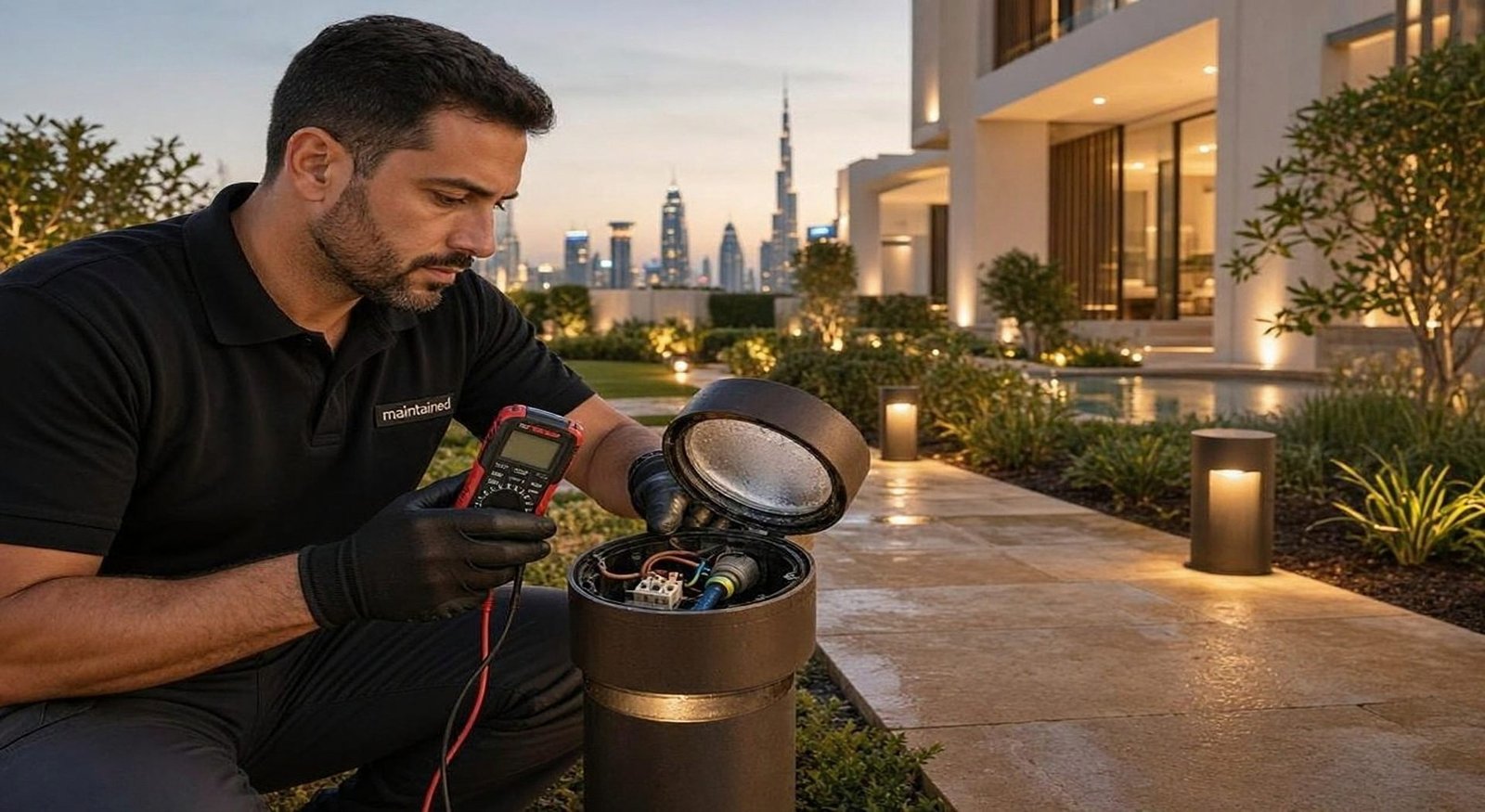
It’s usually the same sequence. The garden lights worked all winter, then the first proper irrigation cycle of summer runs, and by evening half the lights are out. Or the breaker trips every time the garden circuit comes on, and resetting it holds for a day at most before it goes again.
Outdoor lighting is the hardest-working electrical circuit in a Dubai villa, and it fails more often than anything indoors. Heat, dust, irrigation water, salt air if you’re near the coast — the fittings and cabling take all of it year-round. This guide covers why garden lights fail, why they trip the breaker, and what a proper fix looks like rather than another lamp swap.
Why Garden Lights Fail So Often in Dubai
Three things do most of the damage, and they overlap.
- Irrigation water — the same system keeping the garden alive is often the thing drowning the lighting circuit. Sprinkler heads that overspray onto fittings, drip lines running alongside buried cable, and irrigation timers that come on after the lights are already on — all of it finds its way into joints and enclosures that were supposed to stay dry.
- Heat and UV — cable insulation and plastic fittings degrade under direct sun. A fitting that’s rated for outdoor use in Europe is often being asked to survive 50°C surface temperatures and relentless UV, and the seals harden much faster than the manufacturer’s data sheet assumes.
- Dust and sand — fine dust settles into every gap. It holds moisture against terminals, it clogs drainage channels inside fittings, and over time it turns a waterproof enclosure into a damp one. If your garden and irrigation team in Dubai is already maintaining the planting and irrigation, it’s worth asking them to flag any lights that are sitting in the spray zone.
Outdoor Lights Tripping Breaker: What It Actually Means
A garden circuit that trips the breaker is telling you there’s a fault to earth, not a failed lamp.
Earth fault from moisture
This is the most common cause. Water gets into a junction box, a fitting, or a buried cable joint, and current finds a path to earth. The RCD or RCBO trips to protect you. Once the circuit dries out, it may hold for a few days before the next irrigation cycle sets it off again — which is why the fault seems intermittent.
Cable fault underground
Buried garden cable is vulnerable to a lot of things: garden tools, root growth, ground movement, and the slow degradation of the outer sheath. A nick in the sheath lets moisture in, and from there the copper corrodes until the fault is solid enough to trip. Finding it requires insulation resistance testing on the circuit, not a visual inspection.
Failed transformer or driver
Most garden lighting in Dubai runs on low voltage through a transformer, or on 230V with an LED driver in each fitting. When the transformer or a driver fails, it can short internally and trip the breaker feeding it. If the breaker trips only when the transformer is connected, that’s your answer.
Quick reference: symptom, cause and what’s needed
- Trips after irrigation or rain — Most likely cause: water in a joint or fitting (earth fault). What’s needed: locate and re-seal, or replace enclosure.
- Trips immediately when circuit switched on — Most likely cause: cable fault or failed transformer. What’s needed: insulation testing and cable trace.
- Lights out but breaker holds — Most likely cause: transformer, driver, or lamp failure. What’s needed: test at the transformer first.
- Blinking or going on and off — Most likely cause: loose connection or failing driver. What’s needed: inspect terminations and drivers.
Garden Lights Not Working but Breaker Not Tripping
If the breaker holds and the lights still don’t come on, the fault is downstream — usually at the transformer, the driver, or the cable between them.
Garden lighting transformer failure
Low-voltage garden lighting runs on a transformer that steps 230V down to 12V or 24V. These transformers sit outdoors in a housing, and in Dubai that housing is being cooked daily. When a transformer fails, the whole run of lights goes dark at once. That pattern — every light on the circuit dead, breaker fine — is the classic sign.
Before replacing it, check the obvious: is the transformer actually receiving power, and has the breaker for it tripped somewhere else on the board? It’s surprisingly common to find the garden transformer on a circuit that’s been switched off and forgotten.
Garden lighting transformer sizing
If a transformer has been replaced before and the lights keep failing, sizing is worth checking. A transformer that’s undersized for the total wattage of the fittings will run hot and fail early, especially in summer. When the garden has gained extra fittings over the years — a new path light here, a feature light there — the transformer often hasn’t been upgraded to match. That’s one of the most common garden lighting mistakes we find on villas where the system has been extended piecemeal.
Garden light not working — one fitting, not the whole run
If only one light is out, the fault is local: a failed lamp, a failed driver inside that fitting, or a corroded connection at the fitting’s terminal. On a low-voltage system, a single failed lamp won’t usually take the run down, so this is a straightforward replacement. On a 230V system with individual drivers, a failed driver can sometimes affect the rest of the circuit — worth testing rather than assuming.
Yard Light Keeps Going On and Off: Flicker and Blinking
Outdoor lights that blink or cycle on and off are usually telling you about a loose connection or a driver on its way out.
A loose terminal at a junction box, or a corroded connection at a fitting, creates a resistance that varies with temperature and moisture. As it heats and cools through the evening, the contact makes and breaks — and the light blinks. It’s often worse after rain, which is the giveaway.
A failing LED driver produces a similar pattern, but usually without the moisture link. If the blinking happens on dry evenings too, suspect the driver.
There’s also a less obvious cause: a photocell or timer that’s set incorrectly, or a photocell that’s failing and reacting to its own light output. If the light comes on at dusk and then blinks off and on repeatedly, that’s worth checking before pulling fittings apart.
Garden lights tripping the breaker or going out?
Contact MAINTAINED now. We attend, test the circuit and find the fault across Dubai.
Waterproofing: IP Rating and Junction Boxes
Most garden lighting failures trace back to one of these two, and both are fixable permanently rather than temporarily.
What IP rating actually means
IP ratings have two digits. The first is protection against solids (dust), the second against liquids (water). An IP65 fitting is dust-tight and protected against water jets. IP44 is splash-resistant only. For garden lighting in Dubai, IP65 should be the minimum for anything exposed, and IP68 for anything that might sit in standing water or be buried.
The common mistake is buying a cheap IP44 fitting for a garden and expecting it to survive. It won’t. The second common mistake is installing a properly rated fitting but sealing the cable entry badly — the fitting is IP65, the gland is not, and water gets in through the back.
Waterproof junction box — the part everyone skips
Junction boxes are where garden circuits fail most often. A standard indoor junction box in a garden is a guaranteed future fault. A proper waterproof junction box, with correctly sized cable glands and a good seal, is what the circuit needs.
If the wall-mounted transformer or junction box also needs its housing replaced or resited, the wall around it often needs making good afterwards. Our plaster and wall repair team in Dubai handles that side so the finished job doesn’t leave a bare patch on the villa wall.
Outdoor Light Failure After Irrigation: Finding the Source
When the fault is clearly tied to irrigation, the fix isn’t just resealing the joint that failed — it’s stopping water reaching the circuit in the first place.
That means checking the irrigation layout against the lighting layout. Sprinkler heads pointed at fittings, drip lines running over buried cable joints, and pop-up heads that spray higher than expected all need adjusting. If the irrigation system itself is leaking — a cracked pipe, a failed valve — that water is going somewhere, and it’s often into the ground around a garden light. Our leak detection and irrigation repairs in Dubai team can trace the water back before the electrical repair is done, so the fault doesn’t recur after the next watering cycle.
When to Book Outdoor Lighting Repair
Book a repair if the breaker is tripping more than once, if a whole run of garden lights is dead, if lights are blinking or cycling, or if a fitting is visibly damaged or full of water. A single failed lamp doesn’t need a call-out, but a tripping circuit does.
Before the electrician arrives, note two things: whether the trip happens at a specific time (when irrigation runs, at dusk, after rain), and whether it happens immediately on switching on or after a delay. Those two details narrow the fault down faster than anything else.
If the repair turns out to involve more than the lighting — a damaged wall box, a section of garden that needs re-planting around a new cable route, some small making-good after the fix — our multi-skilled repairs in Dubai can usually handle it in the same visit rather than bringing in three trades.
Book an outdoor lighting repair in Dubai and get the circuit properly tested rather than guessing at fittings. We cover Dubai-wide, and if the real problem is the irrigation rather than the wiring, we’ll tell you that too — the last thing you need is a repaired circuit that fails again after the next watering cycle.
Frequently Asked Questions
Why do my garden lights keep tripping the breaker?
Almost always an earth fault — water getting into a joint, a fitting, or a buried cable. The RCD is doing its job by tripping. It may hold for days after the circuit dries out, then trip again after the next irrigation cycle. The fix is finding and sealing the water entry point, not resetting the breaker repeatedly.
Why are my garden lights not working when the breaker is fine?
If the breaker holds and nothing lights up, the fault is downstream. On a low-voltage system, a failed transformer is the most common cause — every light on the circuit goes out at once. On a 230V system with individual drivers, it’s more likely a cable fault or a failed driver. Testing at the transformer first is the quickest way to narrow it down.
Can I just replace the garden lights with new ones?
You can, but if the fault is in the cable or the transformer, new fittings will fail the same way. Replacing fittings without testing the circuit is the most expensive way to solve a garden lighting fault. Test first, then replace what’s actually failed.
What IP rating should garden lights have in Dubai?
IP65 minimum for anything exposed above ground, and IP68 for anything buried or potentially sitting in water. The fitting rating only works if the cable entry is sealed properly too — a good fitting with a bad gland still fills with water.
Outdoor and garden lighting repair in Dubai
We attend, test the circuit properly and find the real fault rather than guessing at fittings. We cover Dubai-wide.