

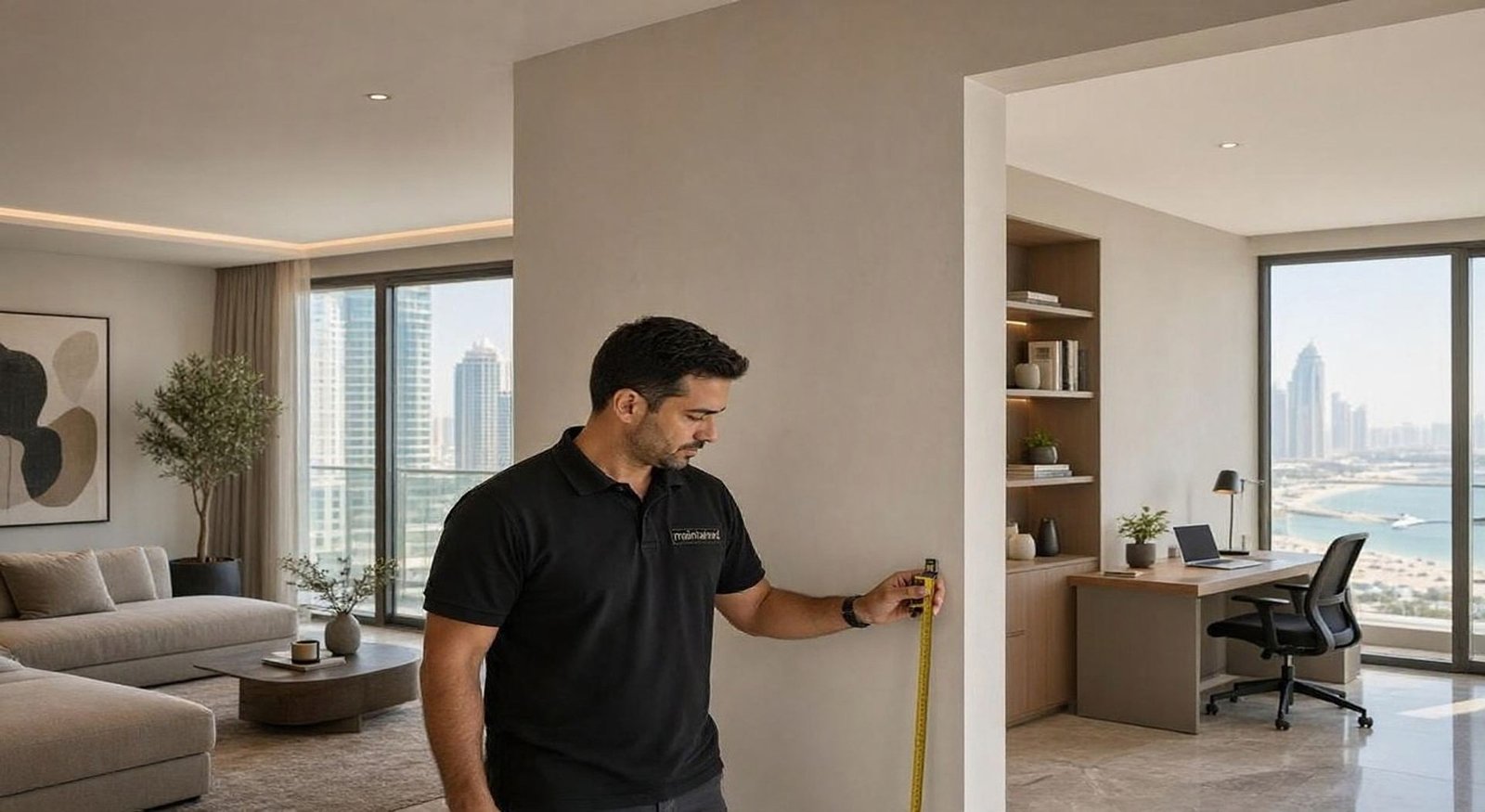
Adding a room without adding to the building is an increasingly common request in Dubai. A study off the living room, a guest space that doubles as storage, a section of a large JBR apartment carved out for a home office — a partition wall is the cheapest way to divide a space that already exists.
The decision usually comes down to two materials: gypsum board or timber. Both work. But they behave very differently on cost, sound insulation, fire performance and the mess involved in installing them — and choosing badly means living with the wrong wall for years. This guide sets out what actually matters when you’re deciding between the two.
What Is a Partition Wall and Why Material Choice Matters
A partition wall is a non-load-bearing internal wall — it divides space but doesn’t hold up the building. That’s the key difference from a structural wall, and it’s why you have far more flexibility in what it’s made from.
Partition walls are made from a metal or timber stud frame, covered with a facing material on each side. The facing is where the two main options diverge: gypsum board, or timber panels and joinery. The stud frame behind is broadly similar in both cases, which is why the labour cost of installing a partition is often closer than people expect — it’s the materials and finishing that make the difference.
Both materials are used in villas across Dubai and in apartments where a landlord allows internal changes. The choice usually comes down to four things: how much it costs, how well it stops sound, how it performs in a fire, and how quickly it can go up without disrupting the household.
What Is a Gypsum Partition and How It’s Built
A gypsum partition is a stud wall faced on both sides with plasterboard — the same board used for drylining ceilings and walls. The studs are usually galvanised steel, the joints are taped and skimmed, and the finished surface is painted or papered exactly like a plastered wall.
The gypsum board partition materials are straightforward: gypsum core, paper facing on both sides, metal studs, and screws. Higher-spec versions add acoustic insulation inside the cavity, a moisture-resistant board in bathrooms, or a fire-rated board where needed. From the outside, once it’s decorated, a gypsum partition is visually indistinguishable from a solid wall. That’s part of its appeal in period-style interiors or apartments where the landlord wants a clean finish.
Gypsum partition minimum thickness and double layer options
The standard single-layer gypsum partition is around 100mm total thickness — a 70mm stud plus a 12.5mm board on each side. A double layer gypsum partition adds a second board on each face, bringing the total to about 125mm and significantly improving both acoustic and fire performance without taking much more floor space.
For most villa applications in Dubai, a single-layer partition is fine. Where sound matters — a bedroom or a study next door to a living room — the double layer version is worth the extra cost.
Gypsum wall partition section
The section of a gypsum wall partition is a simple sandwich: board, stud cavity, board. The cavity is where the acoustic insulation, electrical cabling and any structural bracing sit. It’s also where a fire-rated partition gets its performance, because the board and insulation together resist the passage of fire from one side to the other for a rated period.
The finished job includes taping and jointing the boards, two coats of skim over the joints, sanding, and then decoration. That’s why we bring in our gypsum partition installation team in Dubai to run the whole job from first stud to painted wall, rather than leaving the finishing to a different trade.
Wooden Partition Walls: Types, Thickness and Where They Work
A wooden partition is a timber frame faced with timber panels, slats, or fitted joinery. It’s more decorative than a gypsum wall by nature — the wood is meant to be seen, not painted over — and it suits rooms where the partition is part of the design rather than purely functional.
Types of wooden partition walls
The most common variations are slatted screens (timber battens over a solid backing), panel walls (flat timber panels covering the full surface), and joinery-based partitions that include built-in storage, shelving or a media unit. A wooden partition wall with a door — usually a sliding or pocket door — is a natural choice for a dining room divider or a study entrance. A wooden partition wall with TV unit or storage works well in a living room where the partition is doing double duty.
For a villa where the goal is a room that feels like it belongs, wooden partition walls for living room use are the standard option. In apartments, the fire regulations usually limit how much exposed timber is allowed, which is where the material choice gets more technical — more on that below.
Wooden partition wall thickness and dimensions
Timber partition wall thickness varies more than gypsum. A slatted screen on a stud frame is often 75–100mm; a joinery-based partition with built-in storage can be 300mm or more because the depth is doing useful work. The thickness you choose should be driven by what the partition needs to do — a screen, a room divider, or a wall with a wardrobe built into it are different structures.
Because wooden partitions are made to measure, the finish is usually carried out by a joiner. Our custom wooden joinery team handles this side, and we coordinate the two trades where a client wants, say, a gypsum wall to the back of a room and a timber feature to the front.
Gypsum vs Wooden Partition: Cost Comparison
Cost is where the two options separate most clearly, and it isn’t just a materials difference — the finishing labour is different in each case.
Gypsum partition wall cost
A standard single-layer gypsum partition with taping, skimming and painting typically runs in the range of 180–280 AED per square metre in Dubai, depending on the board specification, the height of the wall, and the level of finish. A double-layer acoustic version pushes that up by roughly 20–30%, and fire-rated boards add further. The finishing — skimming, sanding and painting — is a significant portion of the total, because a gypsum wall has to be finished like a plaster wall.
Wooden partition wall price per sq ft
Timber partitions vary more widely because the material choice is so variable. A simple slatted screen might start around 250–400 AED per square metre, while a full joinery partition with built-in storage, integrated lighting and a sliding door can run to 900–1,500 AED per square metre or more. The range depends on the species, the finish, and how much of the partition is furniture rather than wall.
- Typical cost (AED/m²) — Gypsum partition: 180–280 (single layer, painted). Wooden partition: 250–1,500 depending on spec
- Thickness — Gypsum partition: 100mm standard, 125mm double. Wooden partition: 75–300mm depending on type
- Sound insulation — Gypsum partition: good with insulation, excellent double layer. Wooden partition: moderate unless designed for acoustics
- Fire rating — Gypsum partition: easily rated — 30, 60 or 120 minutes. Wooden partition: limited; exposed timber reduces rating
- Installation speed — Gypsum partition: fast — a small partition in 2–3 days. Wooden partition: slower — joinery is made to measure
Thinking of adding a partition wall?
Contact MAINTAINED for a site visit and an honest assessment of which material suits your space and building before you commit.
Soundproofing and Fire Rating: Where Gypsum Wins
These are the two areas where the comparison isn’t close, and both matter more in Dubai than people often realise.
Fire-rated partition performance
A gypsum partition can be built to a fire rating — 30, 60 or 120 minutes of resistance — using fire-rated boards and mineral wool in the cavity. This is standard for apartment partitions in Dubai, and it’s a requirement in most buildings when a new internal wall is created. A fire-rated partition is tested as a system, so the board, the studs, the insulation and the jointing all have to be specified together.
Timber partitions are much harder to rate. Exposed timber is combustible, and even with fire-retardant treatment, a wooden partition will typically achieve a lower rating than a gypsum equivalent at the same thickness. In a JBR apartment where the building’s fire strategy matters, this often rules out a full timber partition — even if the client loves the look.
Acoustics and soundproofing
Gypsum partitions stop sound far better than timber because the mass of the board and the decoupled stud cavity absorb sound energy. A single-layer partition with acoustic insulation in the cavity performs well; a double layer performs very well. Timber partitions transmit sound more readily unless heavily engineered, because the timber frame itself is more resonant.
For a bedroom or study, gypsum is the sensible default. For a decorative screen in a living room where privacy isn’t the goal, timber is fine.
Speed, Mess and Living in the House During the Work
A gypsum partition is faster to install and cleaner to live with. The studs go up in a day, the boards follow, and the skimming is finished within a few days. Dust is contained reasonably well if the room is sealed off, and the noise is mostly during the framing and boarding phases.
A timber partition takes longer because much of the work is joinery — measured, cut, assembled and finished. The final fitting is usually done after the pieces have been made in a workshop, so the on-site disruption is often less noisy but longer overall. If the partition includes integrated lighting or a TV unit, the electrical and AV coordination adds time — our electrical team handles the wiring for either type of partition, and coordinating the trades early avoids rework.
Either way, the room needs to be emptied, and the decorating team needs access at the end. Our painting and decorating team in Dubai finishes the surface to match the surrounding room, which is often the difference between a partition that looks like an addition and one that looks like it was always there.
Which One Fits a Villa or Apartment in Dubai?
For most applications, gypsum is the better default. A new room in a villa — a home office, a guest space, a partitioned section of a large living area — is better served by gypsum on cost, speed, sound insulation and fire rating. The finish can match the existing walls exactly, and the whole job can be done without the disruption of bespoke joinery.
Timber is the right choice when the partition is part of the design rather than just a wall — a slatted screen, a feature partition with built-in storage, a divider with a sliding door, a media wall in a living room. In those cases, the extra cost and time buy something a gypsum wall can’t offer, which is a piece of furniture that also functions as a wall.
In apartments — particularly in areas like JBR where the building has a fire strategy and the landlord or building management has requirements — gypsum is usually the only compliant option for a full-height partition. A timber screen can sit in front of a gypsum wall for the aesthetic effect, but the structural wall itself has to be gypsum for rating purposes.
If the partition is going into a room where the AC will now be dividing the space, it’s worth having the airflow checked at the same time — our AC and ducting team in Dubai can confirm the room will still cool properly after the new wall goes in.
When to Book a Partition Installation in Dubai
If you’re planning a partition, book a site visit before committing to a material. The best choice depends on what’s above the ceiling, what the building’s fire requirements are, and whether the room you’re dividing has been designed for the extra load on the AC. A short assessment answers all three, and it’s a much cheaper conversation than discovering halfway through that a timber partition isn’t permitted.
For a JBR apartment where you’re adding a bedroom or study, gypsum is almost always the right call, and it can be done quickly. For a villa living room where the partition is the feature, timber is worth the cost. And if the job involves both — a gypsum structure at the back and a timber screen at the front — we can run both trades together.
Get a partition quote and we’ll tell you honestly which material makes sense for your space, your building and your budget. We cover Dubai-wide, including JBR and the wider Marina area.
Frequently Asked Questions
What is the minimum thickness of a gypsum partition?
Around 100mm total for a single-layer partition — 70mm steel stud plus 12.5mm board on each side. A double-layer version is around 125mm. Anything thinner is unusual and limits the acoustic and fire performance.
What are partition walls made of?
A partition wall is a stud frame — steel or timber — covered on both faces. Gypsum partitions use plasterboard, timber partitions use wood panels, slats or joinery. The frame is usually similar; the facing material is what defines the type.
Is a gypsum or wooden partition better for soundproofing?
Gypsum, by a significant margin. The mass of the board plus an insulated stud cavity stops far more sound than timber. If the room needs to be private — a bedroom or a study — a double-layer gypsum partition with acoustic insulation is the standard choice.
Can I use a timber partition in a Dubai apartment?
Rarely for a full-height structural partition, because most buildings require a fire-rated wall for internal additions. A timber screen in front of a gypsum wall is possible, and often the best compromise between compliance and appearance.
How much does a gypsum partition cost in Dubai?
Around 180–280 AED per square metre for a single-layer partition including taping, skimming and painting. Double-layer acoustic versions add roughly 20–30%, and fire-rated boards add further. Timber partitions start at a similar level but rise sharply depending on the joinery specification.
Find out which material suits your space
Get a partition quote from MAINTAINED. We cover Dubai-wide, including JBR and the wider Marina area.