

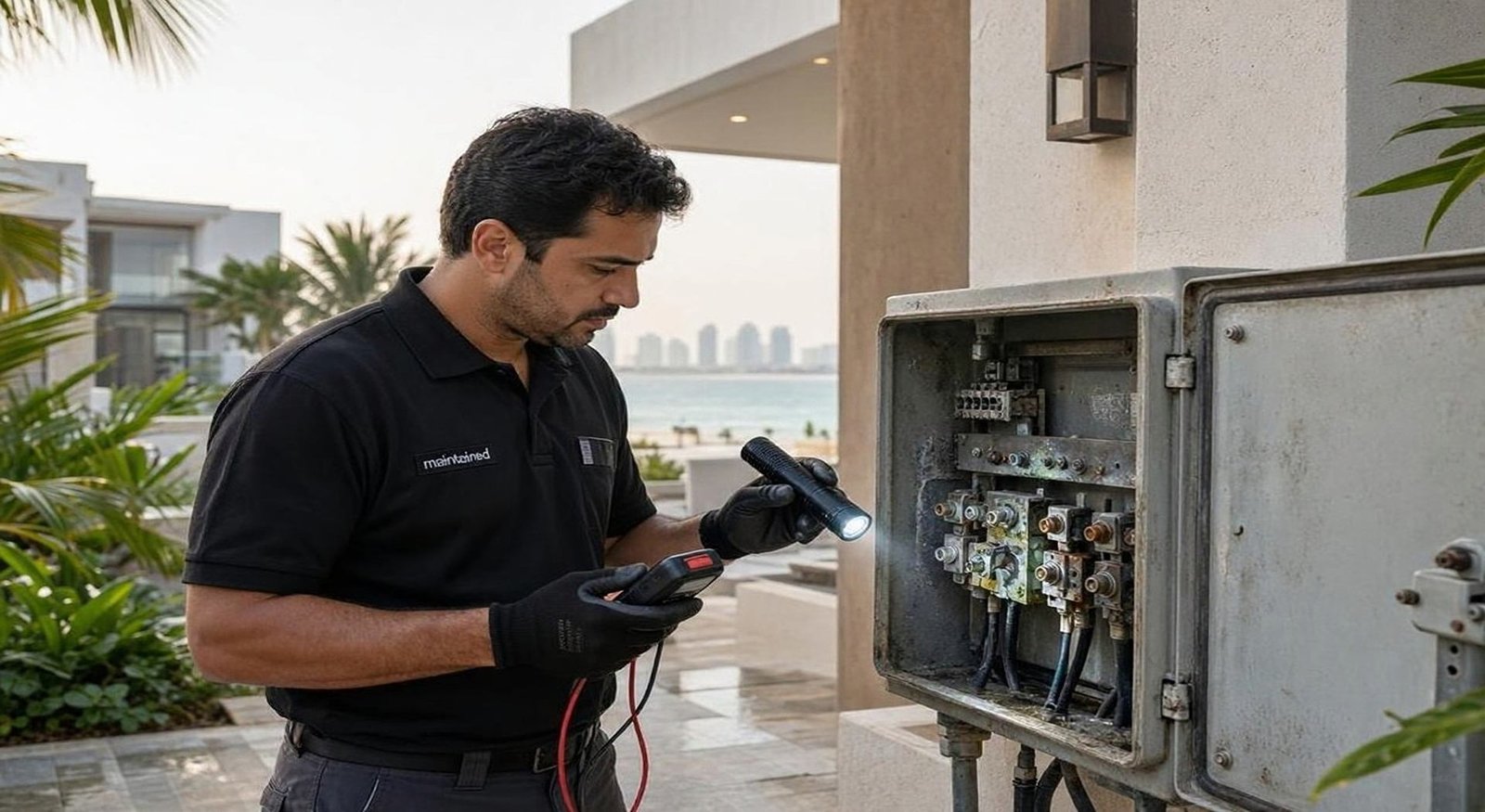
The first sign is usually the outdoor socket by the pool. The flap has gone stiff, the pins inside are green, and the RCD trips every time something is plugged in. Or it’s the DB panel in the garage — the metal enclosure has started to rust along the bottom edge, and one breaker keeps tripping on humid mornings even though nothing has changed.
Saadiyat is one of the most exposed places in Abu Dhabi to build a villa. The salt air and the humidity are not background conditions here — they are the main reason coastal electrical systems fail years earlier than inland equivalents. This guide explains why, what it does to a villa’s electrics, and what a proper electrical inspection in Saadiyat should be looking at.
Why Is It So Humid in Abu Dhabi?
Abu Dhabi sits on the Arabian Gulf, and that geography drives most of the humidity.
From June to September, the prevailing onshore wind carries moisture from the sea over the city. When the air is warmer than the water, it holds that moisture as vapour — and because the Gulf is shallow, it heats up quickly in summer, so the air above it is both warm and saturated. Daytime relative humidity in Abu Dhabi can sit between 60% and 90%, and at night it often climbs higher as temperatures drop and the air can hold less moisture.
Saadiyat, sitting directly on the coast, gets the worst of it. There’s no inland buffer between the villa and the water, so the salt-laden air arrives with nothing to filter it out.
Salt and Humidity: A Combination That Attacks Metal
Salt on its own is corrosive. Humidity on its own is damaging. Together, they do something worse than either would separately.
The mechanism is simple once you see it. Salt particles settle on metal surfaces — busbars, terminals, screws, enclosure panels. Salt is hygroscopic, meaning it pulls moisture out of the air and holds it against the surface. That means a metal part stays wet long after the surrounding air has dried out. The corrosion process needs moisture and an electrolyte, and salt provides both, continuously, for as long as it’s on the surface.
This is why salt against humidity isn’t a comparison — it’s a combination. A villa with high humidity but no salt corrodes more slowly. A villa with salt in the air but low humidity corrodes only when it rains. Saadiyat has both, all year, which is why electrical components here age faster than almost anywhere else in the UAE.
UAE Humidity: House Damage Beyond Electrics
Humidity damage in a UAE villa isn’t limited to the DB and the sockets. It shows up in ceiling plaster, in skirting, in door frames, and in the fabric of the building. If the electrics are already failing from moisture, the building probably is too.
Our plaster and drylining team in Abu Dhabi handles the making-good side once the electrical repair is done, so the villa isn’t left with a working socket and a damp wall around it.
Where Salt Corrosion Hits the Electrics First
Not every part of the system fails equally. These are the ones we see most often on Saadiyat villas.
Corroded electrical connections
Every terminal in a villa is a potential corrosion point. The screws that hold cables in MCBs, the terminals at light fittings, the joints in junction boxes — all of them will corrode faster on the coast than inland. The corrosion creates resistance, the resistance creates heat, and the heat eventually causes intermittent faults or, in worse cases, a small fire behind a faceplate.
This is why an inspection should include torque-checking terminals, not just a visual glance. A terminal that looks fine from the front can be green and crumbling at the back.
DB panel rust in coastal villas
The distribution board is the most vulnerable component in the villa, because it concentrates more metal in one place than anything else in the electrical system.
A DB enclosure is usually steel with a powder-coated finish. That finish holds up well in inland conditions, but salt spray gets into every seam, every cable entry, every fixing hole. Once corrosion starts on the enclosure, it works its way onto the DIN rail, then the busbar, then the terminals. A board that’s rusting along the bottom edge is a board that’s holding moisture inside.
If the enclosure has rust along the seams or around the door, it’s worth replacing rather than repairing — a rusted enclosure is no longer doing its job of keeping the internals dry. Our DB panel replacement service in Abu Dhabi handles both the board swap and the testing that goes with it.
Outdoor socket corrosion
Garden sockets, pool equipment sockets and gate motor supplies are the most exposed points in the system. An outdoor socket that was specified to IP44 will not survive long on a Saadiyat boundary wall. IP65 or IP66 should be the minimum for anything exposed, and IP68 for anything that might sit in standing water during irrigation cycles.
The other common failure is the back of the socket, where the cable enters. Even a well-rated socket with a badly sealed gland will let moisture in, and once it’s in, the terminals corrode from behind. If the outdoor socket is on a garden wall that gets hit by the irrigation spray, it’s worth relocating it rather than just replacing it in the same spot. Our garden and irrigation team in Abu Dhabi can flag any sockets that are sitting in the spray zone.
Quick reference: what corrosion looks like and what it causes
- DB enclosure — looks like: rust along seams and door edges. Causes: moisture inside, breaker faults.
- Terminals and busbars — looks like: green or white crust on metal. Causes: resistance, heat, intermittent faults.
- Outdoor sockets — looks like: corroded pins, stiff flap, water inside. Causes: tripping, shock risk.
- Light fittings — looks like: rust on housing, water in the lens. Causes: flicker, failure, tripping circuit.
- Gate motors and pool equipment — looks like: corroded terminals, failed control boards. Causes: equipment failure, earth faults.
Rust on the DB or sockets that keep tripping?
Contact MAINTAINED now. We test the circuits, inspect the board and outdoor fittings, and tell you honestly what needs replacing and what just needs cleaning and re-sealing.
Tripping in Humid Weather
If the RCD trips more often in summer than in winter, or trips on humid mornings without rain, moisture is finding a path to earth somewhere in the installation. Common locations are outdoor sockets, garden lighting, pool equipment supplies, and the AC condensate area.
The tricky part is that the fault may not be obvious by inspection. Moisture in a fitting can be intermittent — the circuit holds until the humidity rises, then trips, then holds again once the air dries. Insulation resistance testing is the only reliable way to find it. A breaker reset is not a fix; it’s a delay.
If the tripping coincides with the AC running, it’s worth ruling out the cooling system too. A blocked condensate drain can put water into a ceiling void near cabling, which then causes exactly this pattern. Our AC and ducting team in Abu Dhabi handles that side, and we often investigate both together when the cause isn’t clear.
Saadiyat Air Quality and What It Means for the Villa
Saadiyat air quality is generally good in terms of pollution — it’s a low-traffic island with a lot of open space. The issue isn’t pollution, it’s what’s in the air naturally.
Salt particles are constantly present. Sand is carried in on the wind. Moisture is high for most of the year. The combination means every external surface of the villa — including electrical equipment — is being slowly degraded by the environment it sits in. Owners who moved from an inland Abu Dhabi villa often notice the difference within two years: the outdoor sockets fail sooner, the gate motor needs replacing sooner, the DB starts to rust sooner.
That doesn’t mean the villa is badly built — it means coastal properties need a different maintenance rhythm to inland ones.
Protecting the Electrics: IP Ratings and Coastal Maintenance
Most of the prevention comes down to two things: specifying the right IP rating and keeping up with coastal maintenance.
IP ratings have two digits — the first for solids, the second for liquids. For a Saadiyat villa, anything outside should be IP65 minimum, and equipment in a pool or irrigation zone should be IP68. Internal equipment near an opening window or a sliding door should be treated as semi-exposed, because salt air gets in even with the doors closed.
Coastal maintenance means an annual inspection that goes beyond a visual glance:
- Thermal imaging on the DB to spot hot terminals.
- Torque checks on the main connections.
- Insulation resistance testing on outdoor circuits.
- Visual inspection of outdoor sockets, garden lights, and pool equipment.
- Cleaning of any salt deposits inside enclosures.
If the inspection turns up damaged fittings or water ingress around pool equipment, our pool service team in Abu Dhabi handles the pool side of the repair so the electrical fault isn’t masked by a pump issue.
Small repairs around the fix — a re-sealed gland, a replaced cover plate, some making-good on the wall — are usually best handled in the same visit rather than bringing in a second trade. Our multi-skilled team in Abu Dhabi covers those so the inspection visit actually closes the job.
When to Book an Electrical Inspection
Book an inspection if the RCD trips more often in summer, if outdoor sockets look corroded or stiff, if there’s visible rust on the DB enclosure, if the villa hasn’t had an electrical inspection since handover, or if the property has been empty for a season and is about to be occupied again.
Book a repair call rather than an inspection if the RCD won’t reset, if there’s a burning smell at the DB, if water has visibly entered a fitting, or if any socket is hot to the touch. Those aren’t maintenance issues — they’re active faults.
Book an electrical inspection in Saadiyat and get the system checked before the next summer season. We cover Saadiyat, the wider Abu Dhabi coastline, and our Dubai villa clients — and we’ll tell you honestly whether a component needs replacing or just cleaning and re-sealing.
Frequently Asked Questions
Why does my RCD keep tripping in humid weather?
Moisture is finding a path to earth somewhere in the installation. The common locations are outdoor sockets, garden lighting, pool equipment supplies, and the AC condensate area. A proper insulation resistance test finds the fault; resetting the breaker only delays the next trip.
How often should a coastal villa have an electrical inspection?
Every two to three years for a beachfront property, compared with every four to five inland. The salt air and humidity accelerate corrosion on terminals, enclosures and outdoor fittings, so problems develop faster than they would in a drier environment.
Can a rusted DB enclosure just be repainted?
No — repainting the outside doesn’t address moisture already inside. Once rust appears along the seams, the enclosure has lost its ability to keep internals dry, and the terminals inside are usually corroding too. Replacement is the sensible fix.
What IP rating should outdoor sockets have in Saadiyat?
IP65 minimum for anything exposed on a wall, and IP68 for anything that might sit in standing water during irrigation or heavy rain. The rating only works if the cable gland is properly sealed — a good socket with a bad gland still fills with water.
Electrical inspections and repairs in Saadiyat
We test, inspect and repair coastal villa electrics, and tell you honestly what needs replacing. We cover Saadiyat, Abu Dhabi and Dubai.