

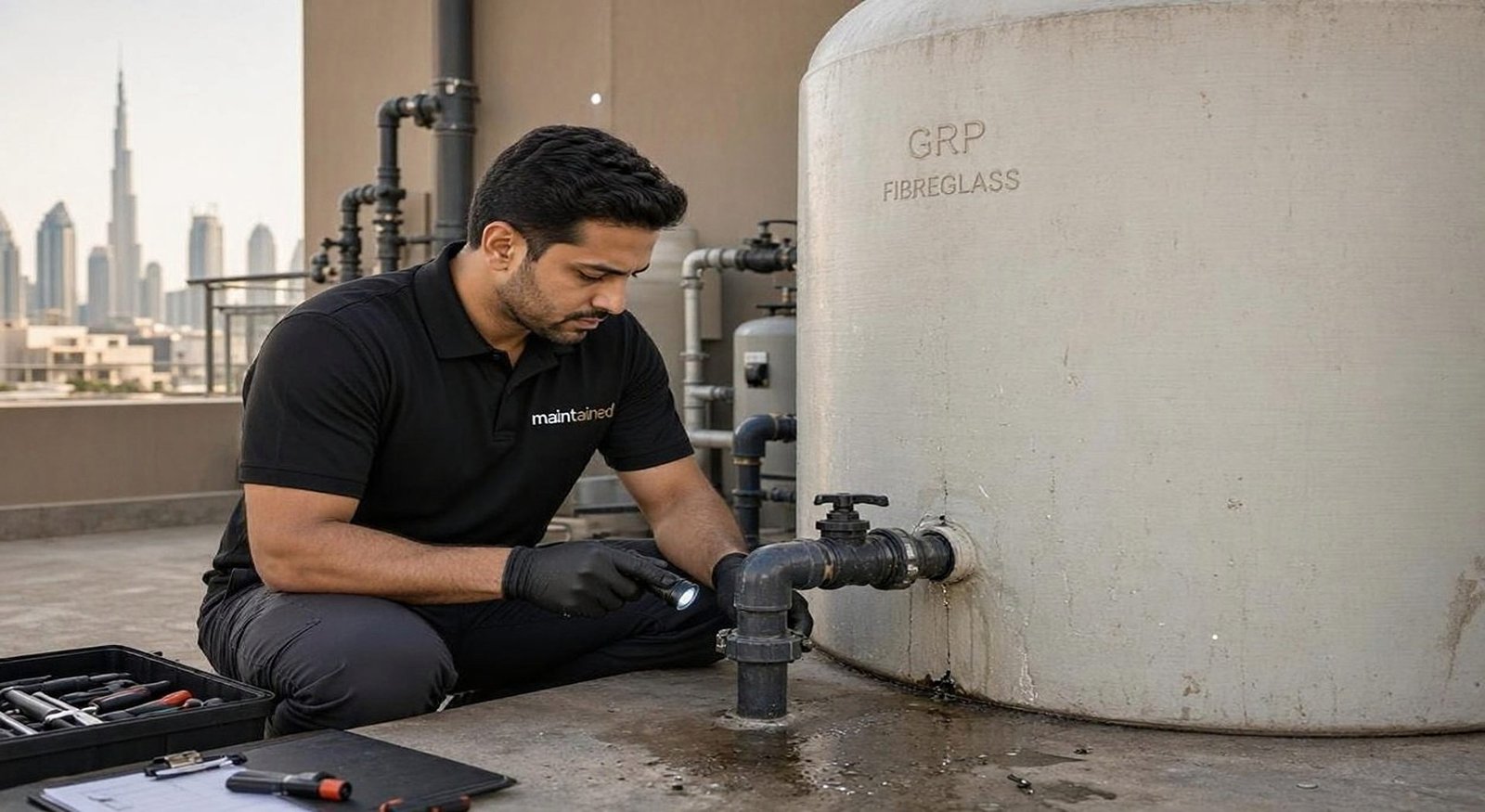
Most villa owners in Dubai discover a tank problem the same way: a damp patch on the ceiling, or water pooling on the floor of a plant room with no obvious source. The tank itself is usually out of sight — on the roof, in a service shaft, or buried under the driveway — so by the time there’s visible water leakage, the crack has been developing for weeks.
GRP (glass-reinforced plastic, or fibreglass) is the standard tank material in the UAE for good reason: it’s light, it resists corrosion, and it’s relatively easy to repair. But it’s not indestructible. Heat cycling, ground movement, poor installation and simple age all take a toll. The question is rarely “is it leaking?” — it’s “can this be repaired properly, or am I throwing money at a tank that needs replacing?”
Why GRP Water Tanks Crack in Dubai
A GRP tank in Dubai lives in conditions the manufacturer’s data sheet doesn’t fully account for.
The first factor is heat. A rooftop tank in July can see surface temperatures well above 60°C. The resin expands, the glass fibres shift microscopically, and over years that thermal cycling creates hairline cracks at stress points — usually at the base, around fittings, or along panel joints.
The second is ground movement. Underground tanks sit in soil that shifts with irrigation and seasonal water table changes. A tank that wasn’t properly bedded on a stable base will flex, and flexing cracks GRP.
The third is installation quality. A tank that was dropped into place, connected without flexible couplings, or had fittings over-tightened during commissioning will fail earlier than one installed with care. We see this constantly in villas where the tank was an afterthought during handover.
Signs you have a leaking water tank
Not every leak announces itself with a flood. Water leakage from the ceiling — usually a brown ring spreading on the plaster below a rooftop tank — is the classic sign. Water leakage on the floor of a plant room or service cupboard is another. Damp patches at the base of a wall, a musty smell in a bedroom, or the pump running more often than it used to (because it’s refilling a tank that’s losing water) are all worth investigating.
If the leak is near a pump, water heater or electrical connection, don’t wait. Water and electricity in the same plant room is the one scenario where you call us and our electrical team at the same time, because a tank leak can damage the very equipment that’s meant to be distributing the water.
Water Leak vs Water Leakage: A Quick Clarification
People use these terms interchangeably, and in most cases it doesn’t matter. But if you’re searching for a solution, the distinction can help you describe the problem accurately to whoever you call.
A “water leak” usually refers to a specific, identifiable point where water is escaping — a cracked fitting, a failed valve, a split pipe. You can point at it. A “water leakage” is often used for the broader symptom: water appearing where it shouldn’t, without an obvious source. When you call, describe what you can see — the ceiling stain, the puddle on the floor, the damp wall — rather than diagnosing it. We’d rather work it out from the symptoms than from a guess.
Cracked Water Tank Repair: What Can Actually Be Fixed
Not every crack means a new tank. GRP is genuinely repairable, and a proper repair can last years — but it depends on where the damage is and how it happened.
GRP water tank leakage repair — what’s involved
The repair process for a GRP tank usually involves draining the tank, cleaning and drying the affected area, grinding back the damaged resin to sound material, and then applying a new layer of resin and glass mat. For larger areas, a waterproof lining may be applied across the whole interior rather than patching just the crack.
The key word is “drying”. A repair applied to a damp surface will fail, and it will fail faster than the original crack did. This is why a proper repair takes longer than people expect — the tank has to be completely dry before any sealing work starts.
How to repair GRP water tank: the process step by step
- Drain and isolate.
- Clean the interior.
- Inspect the whole tank, not just the visible crack — hairline cracks often appear in clusters.
- Grind back to sound material.
- Apply resin and mat in layers, or apply a full waterproof lining if the damage is widespread.
- Cure properly.
- Refill and monitor for 48 hours before returning the tank to service.
If the tank has a metal frame or support structure, that gets inspected at the same time. A crack in the GRP panel is often the first sign of a frame that’s no longer supporting the tank evenly, and repairing the panel without addressing the frame just moves the problem.
Fix cracked plastic water tank: when repair works
Small cracks — usually under 20cm, at a joint or fitting rather than mid-panel — are genuinely fixable and worth fixing. Larger cracks, or multiple cracks appearing across different panels, usually signal that the tank has reached the end of its structural life.
The other consideration is the tank’s location. An accessible rooftop tank is straightforward to repair. An underground tank that requires excavation to access is a different calculation, because the labour cost of getting to it often makes replacement the more sensible option.
When Replacement Makes More Sense Than Repair
We don’t push replacement. If a tank can be repaired properly, we’ll say so. But there are situations where repair is the more expensive choice in the medium term.
- The tank is over 15 years old. GRP has a service life, and a tank that’s been in the Dubai sun for that long has lost much of its structural integrity. A repair on a 20-year-old tank is often the first of several.
- The damage covers multiple panels. One crack is a repair. A tank with cracks on the base, the side panel and around a fitting is telling you the resin has degraded across the whole structure.
- The tank has been repaired before. A second repair in the same area usually means the first didn’t hold, which means the substrate isn’t sound enough to bond to.
- Access is difficult. Underground tanks where excavation is required to repair are often better replaced at the same time, since the excavation cost is the same either way.
- Single crack, tank under 10 years old — Usually the better choice: repair. Why: structural integrity intact, repair is durable
- Crack near fitting or joint — Usually the better choice: repair. Why: common failure point, straightforward to fix
- Multiple cracks across panels — Usually the better choice: replacement. Why: resin has degraded across the structure
- Tank over 15 years old — Usually the better choice: replacement. Why: repair will likely be the first of several
- Underground tank requiring excavation — Usually the better choice: usually replacement. Why: access cost is the same either way
On cost, a GRP tank repair in Dubai is typically a fraction of a full replacement — the difference is usually in the region of a few thousand dirhams versus fifteen to twenty-five thousand for a new tank and installation. The calculation changes when access is difficult or when the tank needs to be removed and reinstated.
Leaking or cracked water tank?
Contact MAINTAINED to arrange an inspection and find out whether your tank can be repaired or needs replacing.
Other Leaks That Aren’t the Tank
Before assuming the tank is cracked, it’s worth ruling out the more common and often cheaper causes.
Water leakage from valve
Pressure relief valves, float valves and isolation valves all fail over time. A valve that’s weeping will produce the same symptoms as a small tank leak — damp patches, water on the floor, the pump running more often. A leaking valve is a small repair, and worth checking before anyone starts excavating.
Water heater leaking Dubai
A leaking water heater often gets misdiagnosed as a tank problem because the two are connected in the same system and the symptoms overlap. If the leak appears near the heater rather than near the tank, it’s worth having the heater checked first — our plumbing team handles both, so the diagnosis isn’t biased toward one solution.
Water leakage from AC
Bedroom water leakage is often attributed to a tank leak when the actual source is the AC. A blocked condensate drain on a split unit above a bedroom ceiling produces exactly the kind of ceiling stain people associate with tank problems. Our HVAC team can rule this out quickly — a drain clean takes under an hour and costs a fraction of a tank repair.
Bedroom Water Leakage and Ceiling Stains: What the Stain Tells You
Where the stain appears is genuinely useful information.
A stain directly below a rooftop tank points toward the tank or its outlet pipework. A stain below an AC unit points toward the condensate system. A stain running along a joist line often means water is travelling from a leak somewhere else before dropping through the plaster.
One thing worth knowing: don’t repaint over a ceiling stain until the source is confirmed. A stain that reappears after being painted is a leak that hasn’t been fixed, and by the time it’s visible again the damage behind the plaster is usually worse than it was the first time. Once the leak is sorted, our drylining and plaster team can reinstate the ceiling properly — a stained, sagging section of plaster needs replacing, not covering.
Tank Waterproofing and Maintenance Water Leaks
The best time to deal with a tank is before it leaks. A maintenance schedule that includes annual inspection, cleaning and a waterproof lining check is far cheaper than repairing a cracked tank, and it’s also a health requirement — a tank that’s leaking inward as well as outward is a tank that’s letting contaminants in.
If the tank serves outdoor irrigation as well as the villa, our garden and outdoor maintenance team can help trace losses on that side of the system, which often get misattributed to the tank itself.
When to Book a Tank Repair
If you have a visible leak, book now. A small crack repaired early is a fraction of the cost of a tank that fails completely and floods a plant room.
If the leak is unclear — water appearing with no obvious source — book an inspection rather than a repair. The inspection rules out the cheap causes first, and there’s no point paying for a tank repair if the actual problem is a valve or an AC drain.
Book a tank repair or inspection and get the system looked at properly. We cover Dubai-wide, and we’ll tell you honestly whether a repair will hold or whether replacement is the sensible call.
Frequently Asked Questions
How do I know if my water tank is cracked or just leaking from a fitting?
Look at where the water appears. Leaks from fittings usually show up close to the fitting — a damp patch at the base of the tank, water around the outlet, corrosion at a valve. Cracks in the tank body tend to produce water on the outside of the panel, often lower down than where the crack actually is. An inspection is the only way to be sure.
Can a cracked GRP water tank be repaired permanently?
A properly repaired GRP tank can last years — it’s not a temporary patch. But “permanently” depends on the tank’s overall condition. A single crack on an otherwise sound tank is a durable repair. Multiple cracks on an ageing tank are a sign that further repairs will follow.
How much does GRP water tank repair cost in Dubai?
For an accessible tank with a single crack, a repair is typically a fraction of replacement cost. The price rises with the size of the repair, whether a full waterproof lining is needed, and access — an underground tank requiring excavation costs significantly more than a rooftop one.
What about a cracked toilet cistern or a WC tank crack — is that the same?
Different system, similar principles. A cracked WC tank is usually a replacement rather than a repair because the cost of a new cistern is low. If the crack is in the ceramic itself rather than a seal or fitting, replacing is almost always cheaper than trying to repair it.
How long does a tank repair take?
A single crack on an accessible tank is usually a one-day job including draining, drying, repair and refilling. Larger repairs or full waterproof linings can take two to three days because of the curing time. Underground tanks with excavation add days for access before the repair even starts.
Get your water tank looked at properly
Book a tank repair or inspection with MAINTAINED. We cover Dubai-wide.