

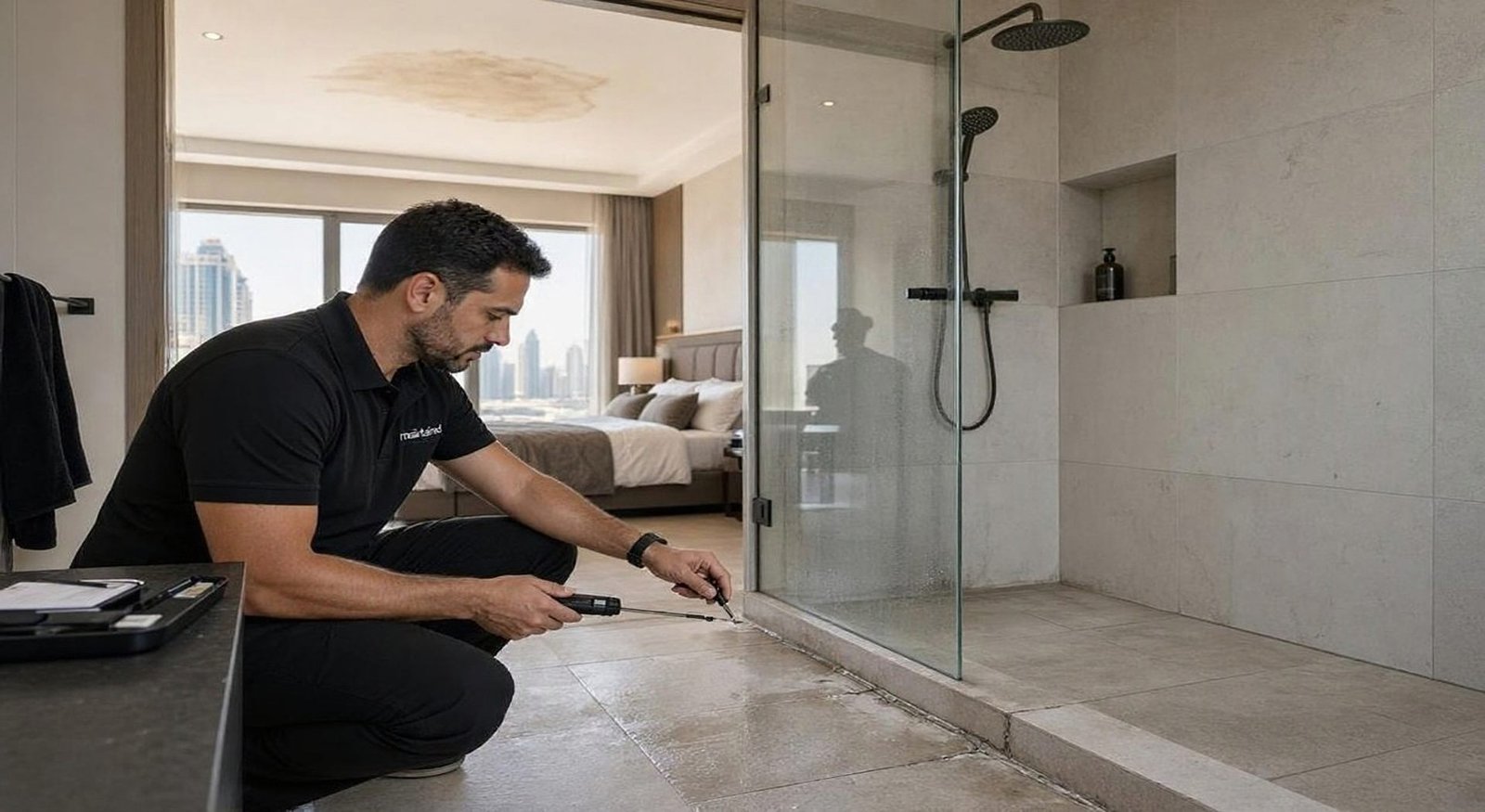
It usually shows up on the ceiling below. A faint brown ring, spreading slowly, directly under where the bathroom sits. Or a musty smell in a bedroom that nobody can trace. By the time the leak is visible from below, the waterproofing under the bathroom floor has usually been failing for months — sometimes longer.
Bathroom tile leaks are one of the most common problems we deal with in Dubai villas, and one of the most misunderstood. The tiles themselves are rarely the cause. Water leaking through bathroom floor tiles almost always points to a failure beneath them: the waterproofing membrane, a cracked screed, a failed shower tray seal, or a pipe that’s been weeping quietly behind the wall.
This guide covers what’s actually happening when water appears through the tiles, how the fault is diagnosed, and what the fix involves — without anyone trying to sell you a full bathroom renovation when a targeted repair would do.
Why Water Leaking Through Bathroom Floor Happens
A tiled bathroom is a layered system. The tiles sit on adhesive, the adhesive sits on a screed, the screed sits on a waterproofing membrane, and the membrane sits on the structural floor. Each layer has a job, and the waterproofing is the one that matters most.
When that membrane fails — through age, movement, poor installation, or a puncture from a pipe or fixing — water gets past it. It travels through the screed, finds the lowest point, and appears wherever it can: through the ceiling below, at the base of a wall, or under the floor in an adjacent room.
Waterproofing membrane failure
The membrane in a Dubai bathroom is usually a liquid-applied polyurethane or a cementitious coating, sometimes a sheet membrane. All of them have a service life, and all of them can be compromised by the conditions in a villa bathroom — constant humidity, thermal movement, and the occasional leak from a fitting above.
A membrane that was applied too thin, or without proper priming, or with insufficient upstand at the walls, will fail earlier than its rated lifespan. In villas where the bathroom was part of a rushed handover, this is a very common finding.
Is the shower leaking through grout?
Grout is porous. Even sealed grout becomes permeable over time as the sealer wears and the grout itself cracks with movement. Water can pass through grout lines and sit in the adhesive and screed beneath.
But grout alone doesn’t usually cause a serious leak if the waterproofing is intact. The waterproofing is designed to handle water that gets past the tile surface. If water is appearing through the ceiling below, the problem is almost always the membrane beneath the grout, not the grout itself. Re-grouting or resealing can help a minor issue, but it won’t fix a failed membrane.
Leaking between tiles and tile coming out of floor
If a tile has lifted or come loose, water gets directly into the adhesive layer rather than passing slowly through grout. This is a much faster route to a leak, and it’s often what turns a slow damp patch into a visible drip.
Loose tiles can be a sign of movement in the floor, a failed adhesive, or water already undermining the bed. Lifting a loose tile is often the first step in a proper diagnosis — what’s underneath tells you almost everything.
Signs of a Bathroom Tile Leak
The symptoms vary depending on where the leak is and how far it’s spread.
Damp ceiling below bathroom
This is the classic sign. A brown or yellow ring on the ceiling directly below the bathroom, often spreading after showers, points to water reaching the structural floor and draining through. If the stain is soft to the touch, the leak is active. If it’s dry and crumbly, the leak may have been fixed already — or may have found another route.
Water leakage from bathroom ceiling inside the bathroom itself is a different problem, usually from the roof or an AC unit above. Our HVAC team in Dubai handles ceiling leaks from AC condensate, which are often mistaken for bathroom leaks.
Water leakage in the bathroom and on the floor
Water appearing on the floor of the bathroom — not from a shower splash, but pooling near the edges or at the base of a wall — is a sign that water is tracking under the tile from a failed joint or membrane. It often appears worse after showers, or after a period when the bathroom hasn’t been used.
Bathroom tiles fading or looking tired
Fading tiles aren’t usually a leak symptom in themselves, but they’re often noticed at the same time. If the tiles have become dull or discoloured, it’s often because the sealer has worn and moisture is getting in. The cosmetic issue is a warning sign that the waterproofing layer isn’t far behind.
Floor Trap Leakage and Shower Pipe Damage
Not every bathroom leak comes from the waterproofing. Two other causes are common and worth ruling out first, because they’re usually cheaper to fix.
Floor trap leakage
The floor trap — the drain fitting in the shower floor — is a common leak point. The seal between the trap and the tile, or between the trap body and the waste pipe, can fail with age. Water then escapes directly under the tiles and into the floor structure.
A trap leak is often visible: a slow drip from the ceiling below, worse when the shower is running. Sometimes you can see staining around the drain in the bathroom itself. If the leak stops completely when the shower isn’t used for a few days, the trap is worth checking first.
Shower pipe damage and leaking shower head
A leaking shower head or a dripping shower valve wastes water but doesn’t usually cause a floor leak — unless the pipe feeding it is damaged behind the wall. If a pipe has cracked or a joint has failed behind the tiles, water finds its way down and out, often appearing at the base of the wall rather than through the ceiling.
The shower is dripping, who could fix it — that’s a plumbing job, not a tiling job, and it’s worth sorting the plumbing side before any tiling work starts. Our plumbing team in Dubai handles shower valve repairs and pipe replacements, and works alongside the tiling team when both are needed.
How a Bathroom Tile Leak Is Diagnosed
Proper diagnosis matters more here than almost anywhere else, because replacing tiles is expensive and the wrong fix just moves the leak.
The process usually goes like this. A visual inspection of the bathroom, checking for loose tiles, cracked grout, movement at the shower tray and staining around the drain. Then a check of the ceiling below, to confirm where the water is actually coming from. If the source isn’t obvious, a moisture meter on the walls and floor gives a picture of how far the damp has spread.
In more complex cases, a flood test is used: the bathroom floor is sealed and filled with water to a shallow depth, and the ceiling below is watched. If water appears, the floor waterproofing is definitely compromised. If not, the leak is likely from a pipe or a fitting rather than the floor membrane.
- Damp patch on ceiling below bathroom — Most likely cause: failed waterproofing membrane. Usual fix: lift floor tiles, re-membrane, retile
- Water pooling on bathroom floor near walls — Most likely cause: failed membrane upstand or grout. Usual fix: targeted repair, reseal or retile
- Leak worse only when shower runs — Most likely cause: floor trap or waste pipe joint. Usual fix: re-seal or replace trap
- Drip at base of wall, not ceiling — Most likely cause: pipe joint behind tiles. Usual fix: pipe repair, then reinstate tiles
- Loose tile, water under it — Most likely cause: failed adhesive or localised membrane damage. Usual fix: lift affected area, repair, retile
Water coming through your bathroom ceiling?
Contact MAINTAINED to get the source of the leak confirmed before any tiles come up.
How Waterproofing Failures Are Fixed
The fix depends on how far the leak has spread, and whether the tiles can be saved.
Targeted repair
If the leak is confined to a small area — a failed seal at the shower tray, a single loose tile with water underneath, a cracked grout line that’s letting water through — a targeted repair is sometimes enough. Lift the affected tiles, dry the substrate, repair or reinstate the membrane locally, and retile. This works when the rest of the waterproofing is sound.
Full bathroom retiling
In most cases where water has been leaking through the ceiling below, the membrane failure covers more than a small patch. Water travels, and by the time it appears on a ceiling, the screed underneath has usually been damp for weeks.
A full retile means stripping the floor and the lower part of the walls, removing the old screed, inspecting the substrate for damage, applying a new waterproofing membrane with proper upstands and detailing at the drain and corners, laying new screed, and retiling. It’s a bigger job, but it’s the one that actually fixes the problem rather than postponing it.
Bathroom retiling cost in Dubai
The cost varies enormously depending on the size of the bathroom, the tiles chosen, and whether the substrate needs repair. A targeted repair to a small area might cost a fraction of a full retile. A full bathroom retile — including waterproofing, screed, and new tiles — is typically in the range of a few thousand dirhams for a small bathroom to considerably more for a master ensuite with premium finishes.
What drives the price more than tiles is the waterproofing and screed work. If the substrate is sound, the job is straightforward. If it needs repair — a cracked screed, water damage to the structural floor — the cost rises. Our drylining and plaster team in Dubai handles the ceiling repair below once the leak is fixed, so you’re not left with a working bathroom and a stained ceiling.
When to Book a Bathroom Leak Repair
If water is appearing on a ceiling below a bathroom, or if you can see water pooling on the bathroom floor without a clear source, book a diagnosis. Every week the leak continues, the damage to the ceiling and the substrate below gets more expensive to fix.
If the problem is a leaking shower head or a dripping tap, book a plumbing visit — the floor and tiles don’t need to come up for that. Our plumbing services in Dubai cover the fittings and pipework, and our tiling team only gets involved if the leak has reached the floor.
And if the bathroom is also due for a refresh — old tiles, tired grout, a shower that’s never quite looked right — the retiling work can fold in the cosmetic upgrade at the same time, rather than doing it twice. Our bathroom tiling team in Dubai handles both the waterproofing and the finish, so the job is done properly in one visit rather than handed between trades.
Book a bathroom leak repair and get the source confirmed before any tiles come up. We cover Dubai-wide, and we’ll tell you honestly whether a targeted repair will hold or whether the bathroom needs a full retile.
Frequently Asked Questions
Is my shower leaking through the grout, or is it something worse?
Grout can let water through, but a leak that reaches the ceiling below usually means the waterproofing membrane beneath the tiles has failed. Re-grouting can help a minor surface issue, but it won’t fix a leak coming from a failed membrane. A proper diagnosis will tell you which one you’re dealing with.
Why is my bathroom ceiling leaking?
Water on a ceiling below a bathroom almost always traces back to the bathroom floor above — a failed membrane, a leaking floor trap, or a pipe joint behind the tiles. Water from an AC unit above the bathroom is another possibility, and worth ruling out first because it’s usually cheaper to fix.
Can I just repair the leaking tiles without retiling the whole bathroom?
Sometimes. A single loose tile with water under it, or a failed seal at a shower tray, can often be repaired in isolation. But if the leak has been reaching the ceiling below, the membrane failure is usually wider than it appears, and a targeted repair just postpones the problem.
How much does bathroom retiling cost in Dubai?
It depends on bathroom size, tiles, and whether the substrate needs repair. A targeted repair is a fraction of a full retile. A full bathroom retile including waterproofing, screed, and new tiles is typically a few thousand dirhams for a small bathroom, rising significantly for a master ensuite with premium finishes.
How long does a bathroom leak repair take?
A targeted repair — a floor trap, a small membrane patch — can be a day or two. A full retile with new waterproofing and screed typically takes one to two weeks, including drying time for the screed and adhesive before tiling. The diagnosis visit will give you a realistic timeline before any work starts.
Get the source confirmed before any tiles come up
Book a bathroom leak repair with MAINTAINED. We cover Dubai-wide.