

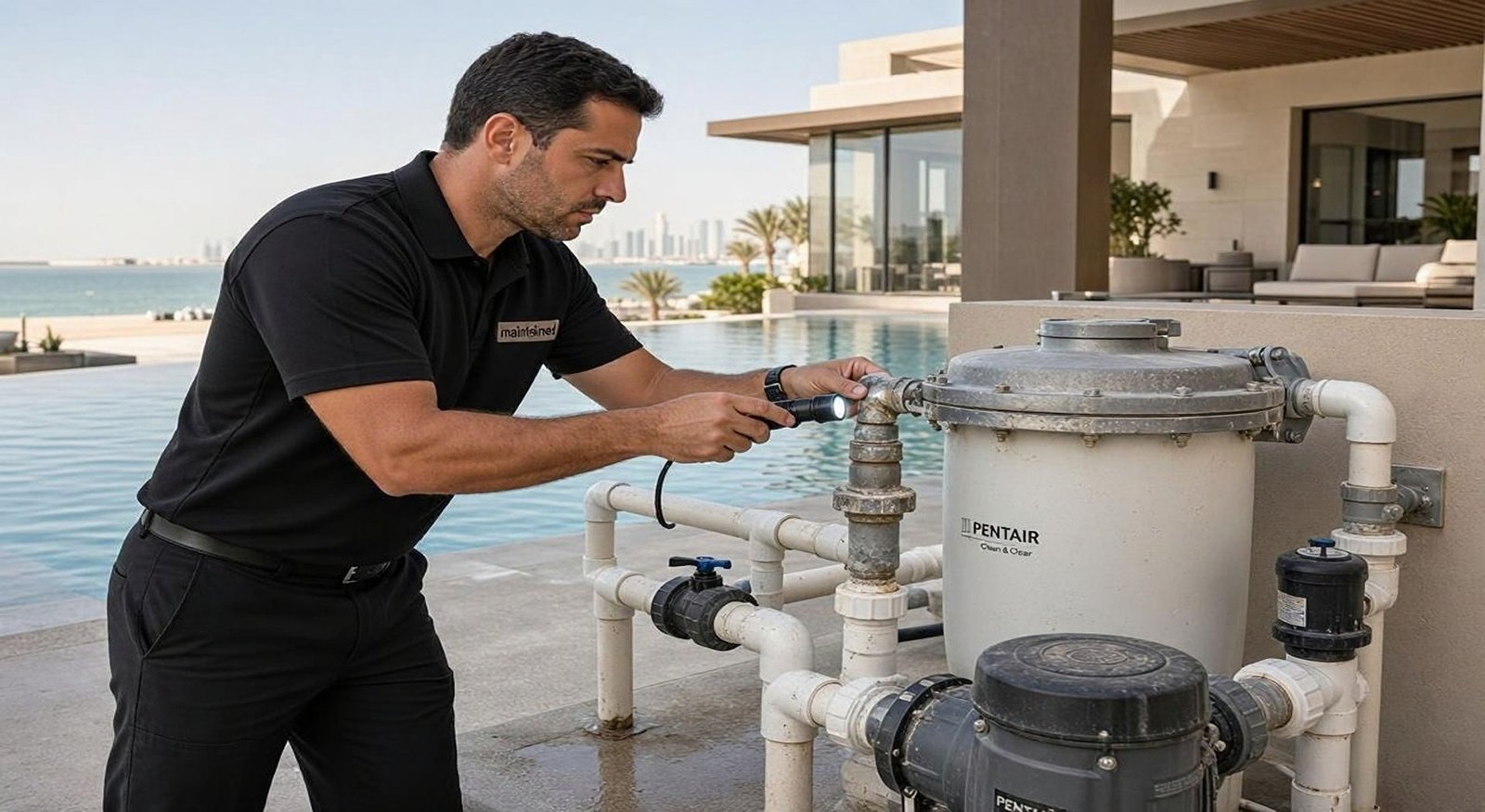
Two years. That’s roughly how long a pool pump lasts on a beachfront villa in Saadiyat if it’s installed and maintained the way it would be in Al Ain. Same pump, same schedule — and yet it corrodes from the outside in, the fittings seize, and the filter housing starts to pit.
We service pools across Saadiyat and the wider Abu Dhabi coastline, and the pattern is consistent. Owners who moved from an inland villa are always surprised by how quickly equipment wears out. Nothing has changed about how they use the pool. What has changed is the air around it.
Why Pool Service Saadiyat Island Is a Different Job From Inland Villas
Three factors work against a pool on this coastline at once.
Salt air carries fine particles that settle on everything — pump housing, filter lid, electrical box, stainless handrails. Salt holds moisture against metal long after the air has dried, and that sustained damp is what accelerates corrosion. Wind-blown sand reaches the pool more easily here than in a sheltered inland compound, raising the load on the filter and settling into pipework joints. And between June and September, humidity means condensation forms on cool metal every night; equipment that dries out by mid-morning inland stays damp for hours on the coast.
Salt Air Pool Equipment: What Corrosion Actually Looks Like
Corrosion rarely announces itself with a dramatic failure. By the time it’s visible, the damage has been developing for months.
The parts that fail first
Stainless steel fittings go first — handrails, ladder mounts, the bolts that hold pump housings together. Grade 316 resists salt reasonably well; grade 304, which is cheaper and common in budget installations, starts to pit within a year on the coast. Next are the pump’s external electrical components — capacitor housing, terminal box, cable entry gland. Salt-laden moisture finds any gap, and the result is intermittent tripping or a pump that fails to start after rain. Then come the filter clamps and pressure gauge. A gauge that reads inaccurately is a small problem until you use it to judge backwashing — then it becomes a larger one.
Why “stainless steel” doesn’t always mean rust-proof
The term doesn’t mean “will never rust”; it means “resists rust under the conditions the manufacturer tested it in”. In a lab, 304 stainless is genuinely stainless. On a beachfront in Saadiyat, exposed to salt spray and daily humidity cycles, it isn’t. When you buy equipment from a supplier who doesn’t specify the grade, you’re often getting 304 for a coastal installation that needs 316.
Pool Pump Corrosion in Coastal Villas
The pump is the heart of the system and the piece that corrodes most expensively.
Signs your pump is on its way out
The earliest sign is noise — a pump that used to hum starts to whine or rumble, usually because bearings have picked up moisture or the impeller has debris. Left alone, bearing noise becomes bearing failure, and bearing failure can crack the housing. The second sign is reduced flow: if the clean-filter pressure reads lower than it used to, the impeller is worn or partly blocked, often by sand that got past the basket. The third is intermittent starting. If the pump trips the breaker or hums without spinning, the capacitor or start winding is failing — usually moisture in the terminal box. If it’s tripping the breaker, get our electrical team involved, because a pump fault can damage the circuit feeding it.
Pool equipment repair service: repair or replace?
For a pump on its first set of bearings, replacing bearings and seals extends life by years. For a pump with a pitted housing, a motor drawing more current than it should, and two prior repairs, replacement is usually sensible. What we advise against is the middle path — new motor on a corroded housing, or a cheap replacement on a system designed for higher spec. That combination fails again within two years, and you’ve paid twice without solving the problem.
- Pump motor and bearings — First sign of trouble: whining noise, reduced flow. Typical lifespan on the coast: 3–5 years
- Stainless fittings (304 grade) — First sign of trouble: brown speckling, pitting. Typical lifespan on the coast: 1–2 years
- Filter housing and clamps — First sign of trouble: pressure drift, corroded clamps. Typical lifespan on the coast: 4–6 years
- Underground pipework joints — First sign of trouble: unexplained water loss. Typical lifespan on the coast: 8–12 years
Filter Problems and What a Proper Pool Equipment Service Should Include
A basic service means emptying the basket, backwashing, and topping up chemicals. That’s fine as far as it goes, but it doesn’t address the media itself. Sand in a sand filter compacts over time and channels form, so water bypasses the sand instead of passing through it. The filter still reads pressure, still looks fine, and is no longer doing its job. A proper pool equipment and service schedule replaces filter sand every three to five years on the coast, checks the multiport valve for seal wear, and confirms the pressure gauge against a known reading.
Cartridge filters are a different case. On a coastal villa they clog faster — every few weeks in summer rather than every couple of months. Keeping a spare set and rotating them is worth the cost, because a clogged cartridge puts back-pressure on the pump, and back-pressure shortens pump life.
Pool Plumbing Problems: The Leaks You Can’t See
Pipework gets the least attention and causes the most expensive repairs. Underground pool plumbing problems rarely start dramatically — they start with a joint that’s slightly loose, a seal that’s degraded, or a section of pipe laid without enough support. Salt air accelerates all of it. Metal fittings corrode, rubber O-rings harden and crack, and solvent-welded PVC joints begin to weep. None of this is visible until it’s caused noticeable water loss or a damp patch in the landscaping. If the pool needs topping up more often, or the garden near the equipment is consistently damp, that’s worth investigating early. Our plumbing team handles pipework and leak detection as part of pool system repairs, and tracing a leak is much cheaper than replacing failed pipework.
Noisy pump, corroded fittings or unexplained water loss?
Contact MAINTAINED to arrange a coastal-specific inspection of your pool equipment.
Pool Cleaning Saadiyat: More Than Skimming Leaves
Sand ingress is a genuine issue here. After a windy week, sand settles in the hopper and along the floor, and if it isn’t removed properly it works into the filter and pump. Brushing walls and floor isn’t cosmetic — it stops algae establishing in textured surfaces and prevents sand cementing in place. Water chemistry needs more attention too. Salt chlorinators work harder at higher temperatures, and stabiliser levels drift. Proper testing means free chlorine, combined chlorine, pH, alkalinity, calcium hardness and cyanuric acid — not just a dip strip and a colour read.
Finding Reliable Swimming Pool Equipment Suppliers in the UAE
The UAE has no shortage of swimming pool equipment suppliers, and the range in quality is enormous. For a Saadiyat pool, the priority is coastal-grade equipment: pumps with sealed motors rated for humid environments, grade 316 stainless where stainless is used, and filter housings with corrosion-resistant clamps. If you’re comparing swimming pool equipment suppliers in the UAE and none can tell you the grade of stainless in their fittings, that’s a warning sign.
If you’re shopping for pool equipment in Dubai and having it installed in Abu Dhabi, the same standards apply. Pool equipment suppliers in Dubai often stock inland-spec units because that’s the bigger market; you need to specify coastal grade rather than accepting what’s on the shelf. A pool shop in Abu Dhabi and a pool store in Abu Dhabi can also carry quite different lines — one may focus on commercial systems, another on residential. For a beachfront villa, you want the one that understands salt corrosion, not the one with the biggest showroom. We don’t sell equipment as a separate business; when we recommend a replacement, it’s because we’ve been servicing that system and know what it needs.
Villa Pool Maintenance Abu Dhabi: A Schedule That Actually Works
- Weekly: water testing, skimming, brushing, basket emptying, visual check on pump and filter.
- Monthly: backwash or cartridge clean, inspection of the pump for noise or leaks, check on the salt cell, and a look at exposed pipework for early corrosion.
- Quarterly: filter media check, pressure gauge calibration, and full system inspection including electrical connections — this is where catching corrosion early saves real money.
- Annually: full service, replacement of worn O-rings and seals, and a decision on components approaching end of life.
The area around the pool matters too. Planting that drops leaves into the water strains the filter, and irrigation that oversprays changes the chemistry. Our garden maintenance team can adjust planting and irrigation so the pool isn’t fighting the landscaping. If the pool deck has salt staining or algae, a proper jet wash once or twice a year keeps it safe underfoot. And if the villa’s water comes from a tank, it’s worth having it checked at the same time — water tank cleaning makes a measurable difference to pool chemistry.
When to Book a Pool Service in Abu Dhabi
If something is already wrong — a noisy pump, a filter that won’t hold pressure, unexplained water loss — book now rather than waiting for the next scheduled visit. Catching a corroded fitting is a fraction of the cost of replacing the pump it connects to. If nothing is wrong but you’ve never had a coastal-specific service, that’s the other reason to book. A pool company in Abu Dhabi that understands Saadiyat conditions will tell you what’s likely to fail next, rather than simply reacting when it does.
Book a pool service in Abu Dhabi and get the system looked at properly. We cover Saadiyat, the wider Abu Dhabi coastline, and our Dubai villa clients — and we’ll tell you honestly whether the pool needs maintenance, repair, or replacement.
Frequently Asked Questions
How often should pool equipment be serviced on a beachfront villa?
Quarterly for the full system, monthly for a visual inspection, weekly for water and cleaning. The salt air makes the difference — an inland pool can stretch to a less frequent schedule, but a Saadiyat pool can’t.
Can I use inland-grade pool equipment on the coast?
You can, but you’ll replace it sooner. Inland-grade stainless (304) and standard motors work, but their lifespan on the coast is roughly half what it would be inland. If you’re buying, specify coastal grade and ask the supplier to confirm the stainless grade.
How do I know if my pool is losing water through a leak or just evaporation?
Evaporation in Abu Dhabi summer can be a centimetre or more a day. The bucket test is the standard way to tell: fill a bucket with pool water, mark the level, place it on the pool step, compare after 24 hours. If the pool drops more than the bucket, there’s a leak.
Do I need to drain and refill a beachfront pool more often?
Usually not, unless total dissolved solids have climbed beyond a workable range. What does need more attention on the coast is the physical condition of the equipment and surfaces — that’s where salt air does its damage.
Get your pool looked at properly
Book a pool service with MAINTAINED. We cover Saadiyat, the wider Abu Dhabi coastline, and our Dubai villa clients.