

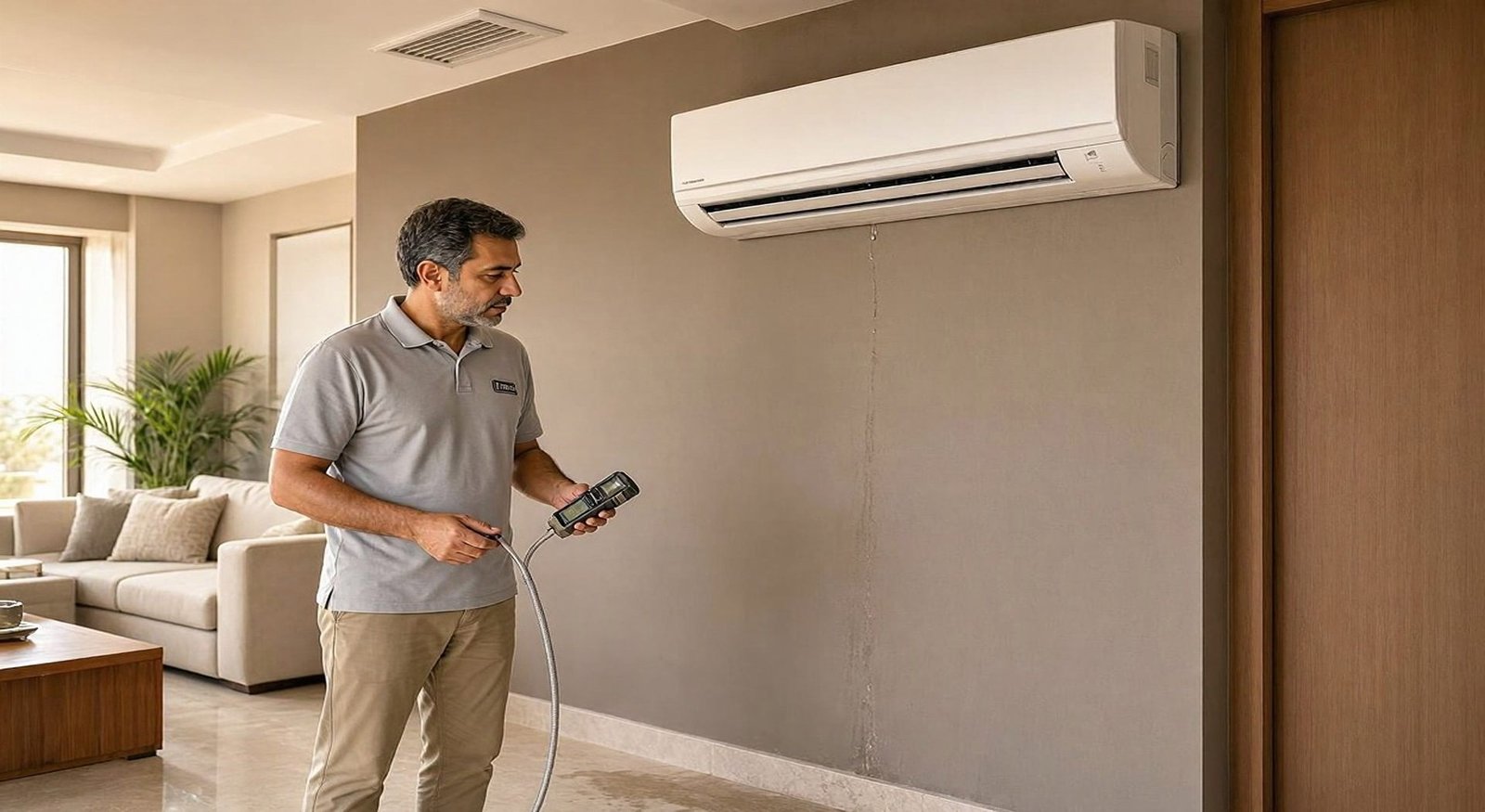
It usually starts with a sound. A faint drip above the hallway ceiling, or a damp patch spreading across the plaster above a vent. By the time most people in Dubai call us, the AC has been running almost continuously since May, and the ceiling has a water stain the size of a dinner plate.
Here’s the reassuring part: an AC leaking water inside the house rarely means the unit is finished. Nine times out of ten it’s a drain problem, and drain problems are fixable in a single visit. The expensive ones are the leaks left for three weeks — because by then you’re paying for the ceiling too.
Why Water Leaking From AC Is Almost Always a Drain Issue
An air conditioner doesn’t create water. It removes it from the air. Warm, humid air passes over the cold evaporator coil, moisture condenses, and that water has to go somewhere. In a healthy system it drips into a drain pan, runs into a condensate drain line, and exits the building.
When that path gets interrupted, the water finds another route — through your ceiling, down a wall, or out of the vent onto the floor. Same water, different exit.
What the condensate drain actually does
The condensate drain is the small PVC or flexible pipe carrying water from the indoor unit to a discharge point outside. It relies on gravity, so it only needs a slight slope. It also relies on staying clear, which in Dubai is a lot to ask.
Blocked drain line AC: the number one cause in Dubai
Fine dust gets past filters, mixes with moisture in the drain pan, and forms a sludge that coats the inside of the pipe. Add the algae that grows in warm standing water and you have a plug. Once the line is blocked, the pan fills, and the pan overflows.
If your system has a float switch, it should cut the unit off before the overflow happens. Many villas in Dubai don’t have one, or have one that failed years ago and was never replaced. That’s when the water ends up in the ceiling instead.
What Does It Mean When Your AC Starts Leaking Water?
The symptom is the same, but the cause changes depending on where the water appears and when.
AC leaking from indoor unit — level and loose connections
If water comes from the body of the indoor unit rather than the vent, the unit may have shifted off level. A wall-mounted split tilted slightly the wrong way sends condensate away from the drain instead of towards it. We see this often where the bracket has settled, or where a handover installation was rushed.
Loose drain connections inside the unit are the other common culprit. A push-fit joint that has worked loose will drip steadily, hidden behind the casing — which is why the first sign is usually a damp patch on the wall below.
Frozen coil — when ice turns into a puddle
A frozen evaporator coil is a strange one, because the leak only appears after the ice melts. Ice builds up on the coil, and the moment it thaws you get a sudden rush of water that looks far worse than a slow drip.
Freezing is usually caused by restricted airflow (blocked filters, a dirty coil) or low refrigerant. Low refrigerant is not something to top up and forget — it means there’s a leak in the circuit. If the unit has also been tripping its breaker, get our electrical team involved alongside the HVAC technician.
Ducted AC leak and AC vent leaking water
In a ducted system, water can appear at the vent rather than the unit. That’s usually condensation on an uninsulated duct run, or a blocked drain in a concealed indoor unit overflowing into the ductwork. Either way, the leak is happening somewhere you can’t see, and the vent is just where it surfaces.
Why Water Is Leaking From the AC Outdoor Unit
Owners often panic at water around the condenser outside. In most cases this is normal — the outdoor unit produces condensate too, and a steady drip during hot, humid weather is exactly what it should be doing.
It becomes a problem when drainage around the unit is poor: water pooling against the wall, soaking the patio, or running towards a boundary. Over time that damages paving and planting. If the outdoor drip is finding its way into garden beds or across a walkway, our garden and outdoor maintenance team can sort the drainage.
What isn’t normal is water from the outdoor unit in winter, or a constant trickle when the system is off. That points to a valve or pipe issue rather than condensate, and it needs a visit.
Water Leaking From AC Vent in House: Why the Ceiling Stain Appears
A water stain from AC leaks is a specific kind of damage. It spreads slowly, darkens the plaster, and almost always reappears after being painted over if the leak hasn’t been fixed.
The reason is simple: the water is travelling. It leaves the drain pan, runs along a joist, and only becomes visible where the plaster is thin enough to stain. The vent you’re looking at may be two metres from the actual leak point.
This is why we don’t recommend patching and painting a ceiling stain until the source is confirmed. Left long enough, ceiling damage goes beyond cosmetics — plaster softens, board sags, and in bad cases the section has to come down. If that’s already happened, our drylining and plaster repair team can reinstate it once the AC is sorted.
- Drip from the vent, unit still cooling — Most likely cause: blocked condensate drain. How urgent: book within a few days
- Water from the indoor unit body or wall below — Most likely cause: loose drain connection or unit off level. How urgent: book this week
- Sudden rush of water after hours of running — Most likely cause: frozen coil thawing. How urgent: switch off, book now
- Ceiling stain spreading, plaster soft — Most likely cause: overflow running along joists. How urgent: switch off, call today
- Water around the outdoor unit only — Most likely cause: normal condensate or poor drainage. How urgent: monitor, address drainage
What to Do When Your AC Leaks Water
Before anyone arrives, there are a few things worth doing — and a few worth avoiding.
- Switch the unit off at the thermostat. It won’t fix the leak, but it stops it getting worse.
- If water is near a socket, light fitting or the consumer unit, isolate that circuit at the breaker. Water and electricity in the same ceiling void is the one scenario where you call us and an electrician at the same time.
- Put a bucket under the drip and towels around it. It protects the floor and shows the technician how much is coming through.
- Don’t tape over the vent or seal the ceiling. The water will find another route, usually somewhere more expensive.
- Don’t open the indoor unit yourself. Beyond the filter, there’s nothing you can safely check.
- Take a photo before you mop up. The size and position of the wet patch helps us identify which part is at fault.
If you’re renting, tell the landlord or property manager the same day. Delay shifts the cost of ceiling repairs onto the tenant in most Dubai tenancy agreements, and that argument is easier to win with a timestamped photo.
AC dripping into your ceiling?
Switch the unit off and contact MAINTAINED to arrange an AC drain clean and inspection.
If Your AC Is Leaking Water, Don’t Just Mop It Up
We understand the temptation. The water stops, the ceiling dries, and the problem seems to have gone away. It hasn’t. The drain line is still blocked, and the next overflow will be bigger.
There’s a second reason not to ignore it. Standing water in a drain pan, sitting at 22°C in a dark ceiling void, is a good environment for mould and bacteria. Once that starts, the unit blows it into the room every time it runs. That’s when people notice a musty smell and unexplained coughing — and by then the pan and coil need cleaning, not just unblocking.
If the leak has been going on a while, it’s worth checking the water quality side too. We often find villas with repeated AC drain issues also have water tanks that haven’t been cleaned in years — different system, same pattern of neglect.
AC Water Leaking Dubai: Why It Happens More Often Here
An AC in Dubai works harder than the same unit would in most of Europe, and the failure pattern reflects that.
Humidity is the obvious factor. From June to September, a typical split unit can produce several litres of condensate a day — all of it passing through a pipe the width of your finger.
Dust is the second factor. Fine desert dust gets past filters, settles in the pan, and turns into the sludge that blocks the line. Units running 24/7 with filters cleaned twice a year are prime candidates.
And then there’s installation quality. A drain line with too little fall, or one that runs uphill for a section because it was easier to route that way, will block faster and overflow sooner. We see this constantly in villas across Jumeirah, JGE and JBR, and in apartments where the indoor unit is boxed into a ceiling void with almost no access.
The same principles apply in Abu Dhabi and to older London homes with comfort cooling, but the frequency is different. Dubai’s combination of heat, humidity and continuous operation makes drain problems a maintenance item rather than an emergency.
When to Book an AC Drain Clean
If the unit is dripping, book now. If it isn’t dripping but hasn’t had a drain clean in over a year, book before summer — it’s a much easier conversation in April than in August with water coming through the ceiling.
A proper drain clean isn’t just a flush. It means clearing the line, cleaning the pan, checking the fall on the pipe, testing the float switch if there is one, and confirming the condensate actually reaches its discharge point. It takes under an hour for a standard split unit and it’s the cheapest HVAC job you’ll ever pay for.
If the leak has already caused damage, we’d rather fix the cause first and the ceiling second. Our plumbing team handles any associated pipework and discharge issues, and we can coordinate the making good afterwards.
Book an AC drain clean and get it sorted before the ceiling tells you again. We cover Dubai-wide, plus Abu Dhabi and London for our existing villa clients.
Frequently Asked Questions
Why is my air unit leaking water even though it’s still cooling well?
Cooling performance and drainage are separate functions. A unit can cool perfectly while its drain line is completely blocked, because the refrigeration circuit is fine — it’s the water removal that’s failed. That’s the most common scenario: the AC feels normal, and the only warning is the drip.
What does it mean if your AC is leaking water only sometimes?
Intermittent leaks usually point to a partially blocked drain that only overflows at peak condensation, or a frozen coil that leaks when it thaws. Note when it happens — time of day, how long the unit has been running, whether it’s particularly humid. That pattern is genuinely useful to the technician.
Can I just unblock the drain pipe myself?
If the drain terminates somewhere accessible outside, you can sometimes clear the last section with a gentle flush. What you can’t do from outside is clear the sludge sitting in the pan and the first metre of pipe, which is where the blockage usually is. Blowing compressed air into the wrong end can push the blockage further in or dislodge a joint inside the ceiling.
Will the water leak damage my ceiling permanently?
Not if it’s caught early. A small stain that dries out can often be sealed and repainted. Once the plaster has gone soft or the board has sagged, that section needs replacing — a drylining job, not a painting job. The longer the leak runs, the more of the ceiling has to come down.
Get your AC leak sorted before the ceiling tells you again
Book an AC drain clean with MAINTAINED. We cover Dubai-wide, plus Abu Dhabi and London for our existing villa clients.