

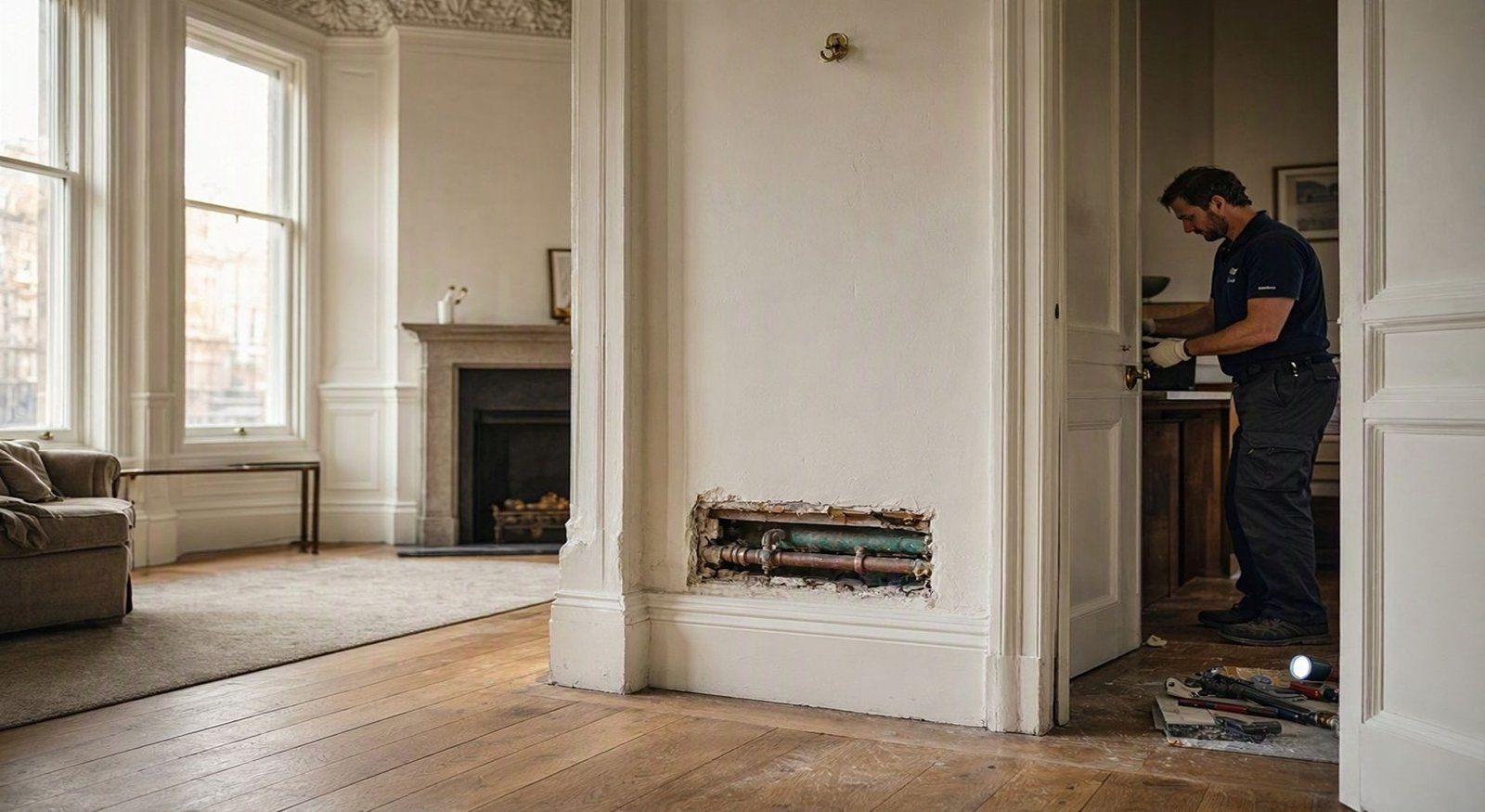
A Georgian or Victorian townhouse in Mayfair will outlive all of us. The pipework inside it usually won’t. Somewhere behind the plaster, under the floorboards and above the cornice, there’s a run of lead or galvanised steel that was installed when gas lighting was still the new thing — and it’s still carrying your drinking water.
We survey these houses often, and the pattern is predictable. The owner has had a plumber out three times in eighteen months for “a small leak,” the water from the upstairs tap has a faint brown tinge first thing in the morning, and nobody has yet asked the obvious question: is it time to replace the pipes rather than patch them again?
This article covers what that old pipework actually is, how to tell when it’s giving up, and what a repipe involves in a period property. The same conversation applies to older villas in Dubai and Abu Dhabi, though the villains there are salt and heat rather than frost and lead — more on that further down.
What Old Plumbing Types Are Still Hiding in Mayfair Homes
Old town plumbing in this part of London is a layer cake. Very little was removed when it was upgraded; most of it was simply abandoned in place and bypassed. A single wall can hide three generations of work.
Lead pipes in old London houses
Lead was standard for domestic supply until well into the twentieth century, and plenty of it survives in Mayfair — usually on the incoming main and the runs to upper floors. It’s soft, grey, and if you scratch it with a coin it marks easily. The health concern is well documented, but the practical one shows up first: lead deforms, cracks at joints, and reacts badly with modern water chemistry.
Galvanised steel and early copper
Galvanised steel was the “modern” replacement and is now the most common source of trouble in houses of a certain age. The zinc coating erodes from the inside out, so the pipe looks sound from the outside while the bore narrows to the width of a pencil. Early copper — thin-walled and often poorly soldered — came next, and it brings its own signature failure.
Signs Your Old Pipes in Home Are Failing
Most failures announce themselves months before anything floods. The trick is knowing which symptoms mean “monitor” and which mean “start budgeting”.
Pinhole leaks in copper — the Mayfair classic
A pinhole leak is exactly what it sounds like: a hole the size of a needle, usually on the underside of a horizontal run, often where the pipe was bent or soldered. You’ll find a small green or white crust on the pipe, a damp patch that keeps coming back, or a ceiling stain that reappears a few weeks after being painted over. One pinhole is a repair. Three in two years is a pipe that has reached the end of its life, and you’re paying twice — once for the repair, once for the ceiling.
Rusty water in Mayfair: what discolouration tells you
Brown water first thing in the morning, clearing after a minute, is the classic sign of internal corrosion. If it’s only one tap, suspect the fitting. If it’s the whole house, suspect the main. Cloudy water that settles is usually air; gritty water that leaves sediment in the basin is usually the pipe itself. Where the water has been sitting in a tank rather than coming straight off the main, the tank itself is worth checking too — water tank cleaning and testing is a sensible first step before blaming the pipework.
Pressure loss, noise and damp that keeps returning
Old plumbing systems lose pressure gradually, so owners adapt without noticing — the shower that used to be strong is now merely adequate. Knocking or hammering when a tap closes points to failed clips and water hammer. Damp at the base of a wall with no roof or gutter explanation is worth tracing back to pipework before you call a damp specialist.
- Brown water on first draw, clears quickly — Most likely cause: internal corrosion in steel or old copper. How urgent: survey within weeks
- Recurring damp patch or ceiling stain — Most likely cause: pinhole leak or failed joint. How urgent: investigate now
- Falling pressure across the whole house — Most likely cause: scale build-up or narrowed bore. How urgent: survey before it fails
- Water visibly escaping or ceiling bulging — Most likely cause: split pipe or joint failure. How urgent: emergency — isolate and call
Seeing the warning signs in your pipework?
Contact MAINTAINED to discuss a pipework survey and find out what is behind the plaster.
Why Old Pipe Repair Only Buys You Time
We’re happy to carry out old pipe repair — sometimes it’s genuinely the right call, particularly on a single accessible run. But it’s worth being honest about what it achieves. A pipe that has corroded from the inside will fail again somewhere else, usually in a less convenient place, usually at a worse moment.
There’s also the access problem. By the time a plumber has found the leak, opened the ceiling, cut out a section and made good, you’ve paid a decent chunk of what a section repipe would have cost. Three of those in a decade and you’ve spent the repipe money without getting the repipe.
How Much to Replace Pipes in a Townhouse?
Anyone quoting you a single number over the phone is inventing it. The honest answer is a range, and a wide one, because the cost is driven by access rather than by pipe.
As an indicative guide, a partial repipe covering the main and one or two bathrooms in a central London townhouse typically lands somewhere between £4,000 and £9,000. A full repipe across four or five floors, with original lath-and-plaster ceilings and listed interior details to protect, can run comfortably past £15,000 once making good and redecoration are counted. Those figures are for London; Dubai villa repiping is priced differently because the labour model and access are different.
What moves the number most:
- Route. Running new pipe through existing voids is cheaper than lifting floors and opening ceilings.
- Number of wet rooms. Each bathroom, cloakroom and kitchen adds runs and isolation points.
- Material choice. Copper, press-fit and composite multilayer all behave differently on price and lifespan.
- Making good. Plaster cornices, panelling, marble and tiling all need a specialist, not a general builder — drylining and plaster repair in Mayfair is a separate trade for good reason.
- Listed status. Consent and method statements add time, and time is the expensive part.
What Replacing Old Pipework Actually Involves
Repiping a period property is a sequencing job before it’s a plumbing job. Get the order wrong and you’ll be repairing decorative plaster you didn’t need to touch.
Survey, isolation and a route plan
First we map what’s there — which runs are live, which are dead legs, where the main enters, and where the new pipe can travel without destroying original fabric. This is where old plumbing supplies become a genuine constraint: lead and imperial-sized galvanised fittings aren’t sitting on a shelf, and searching “old plumbing supplies near me” will send you to a reclaim yard rather than a solution. The right answer is usually to transition to modern materials at the first accessible joint, not to recreate the old system.
Repiping a period property without wrecking it
New runs go through service voids, under floors, behind skirting and through chimney breasts where they’re redundant. Where a ceiling must be opened, we cut neatly, photograph everything and keep the sections for the plasterer. Original lath and plaster can be repaired invisibly by someone who knows what they’re doing; a general patch job will show under a lamp forever.
Fixtures, finishes and commissioning
London plumbing fixtures in older houses are often non-standard — a restored thermostatic shower valve, a cast-iron bath, an antique brass tap set. These need adaptors and care, not force. After installation comes a proper pressure test, a flush, and — where lead was present — a water sample sent for analysis. That last step matters more than people expect, which is why we bring in legionella and water hygiene testing at handover rather than leaving it to chance.
And when the dust settles, the room still needs putting back together. Patching plaster is one thing; matching a hand-painted finish or a period cornice is another — that’s a job for painters and decorators who work in period homes, not for whoever happens to be on site.
Choosing Plumbing Services in London for Period Work
There is no shortage of plumbing services in London. There is a shortage of firms who will happily work in a house where the ceiling is worth more than the van.
A few things worth checking before you appoint anyone:
- Ask for a period-property reference. Not a new-build reference with nice taps — an actual older house where they had to protect cornices and deal with imperial pipe sizes.
- Check reviews, not just names. It’s normal to look up “Mayfair plumbing & heating Ltd” style local firms, but read the reviews for how they handled problems, not just for punctuality.
- Confirm who does the making good. If the answer is “our plumber does a bit of plastering,” ask to see it.
- Insist on insurance and a written method statement for anything involving opening ceilings in a listed interior.
- Get the survey in writing. Photos, findings, recommendations, and a clear split between “monitor” and “replace”.
For plumbing services in London UK-wide, the same principle applies: the cheapest quote is often the one that returns. If you want the full scope of what we cover, our plumbing services page sets it out.
Dubai and Abu Dhabi: Same Symptoms, Different Cause
Owners who split their year between London and the Gulf often ask whether the same advice applies. It doesn’t, quite.
In Dubai and Abu Dhabi villas, pipework fails from the outside in — salt-laden air attacking fittings, hard water scaling the inside of the bore, and heat cycling the joints in roof spaces. Lead isn’t the issue there; chloride corrosion and pressure surges are. The symptoms rhyme, though: falling pressure, recurring damp at the base of walls, water that tastes or smells off after the property has been empty for a season.
If you’re managing properties in both places, it’s worth having the pipework surveyed on the same schedule. A townhouse in Mayfair and a villa on Saadiyat Island will both fail quietly while nobody is looking.
When to Book a Pipework Survey
The sensible trigger isn’t a burst pipe. It’s the second pinhole leak, the third call-out in a year, or a discoloured glass of water you’ve stopped noticing.
A survey takes a couple of hours, tells you what material you’re actually living with, and gives you a plan you can budget for rather than a repair you have to react to. If the answer is “it’s fine for now,” you’ll know that too, in writing.
Book a pipework survey and find out what’s behind the plaster before it finds you. We cover Mayfair, central London, and our villa clients in Dubai and Abu Dhabi.
Frequently Asked Questions
How do I know if I have lead pipes in my old London house?
Look at the incoming main where it enters the property, usually under the kitchen sink or in a front basement. Lead is dull grey, soft enough to scratch with a coin, and any soldered joints on it will look lumpy rather than clean. If you’re unsure, a surveyor can test a scrape sample on site or send a water sample to a lab. In houses built before the 1950s, the default assumption should be that some lead remains somewhere.
Are pinhole leaks in copper a one-off or a warning sign?
One pinhole is a one-off. Two or three within a couple of years, especially on the same run or the same floor, means the pipe wall has thinned from the inside and the rest of that run will follow. That’s the point at which a section repipe becomes cheaper than a series of emergency call-outs.
Can I just repair the pipe instead of repiping the whole house?
Often, yes — and we’ll say so if that’s the case. A single accessible run in good condition is a repair. What we won’t do is recommend patch after patch on a system that has clearly reached the end of its life, because the third or fourth leak always lands in the worst possible place.
Do I have to move out during a repipe?
Usually not. A staged repipe can be done floor by floor with the water off for limited periods each day. For a full repipe of a large townhouse, some owners choose to be elsewhere for two or three weeks, but it’s a preference rather than a requirement. We plan the sequence around your routine.
How long does a townhouse repipe take?
A partial repipe is typically one to two weeks on site. A full repipe of a four or five-storey period property runs four to six weeks including making good, longer if listed consent is involved. The survey gives you a realistic timeline before any work starts.
Find out what’s behind the plaster
Book a pipework survey with MAINTAINED. We cover Mayfair, central London, and our villa clients in Dubai and Abu Dhabi.