

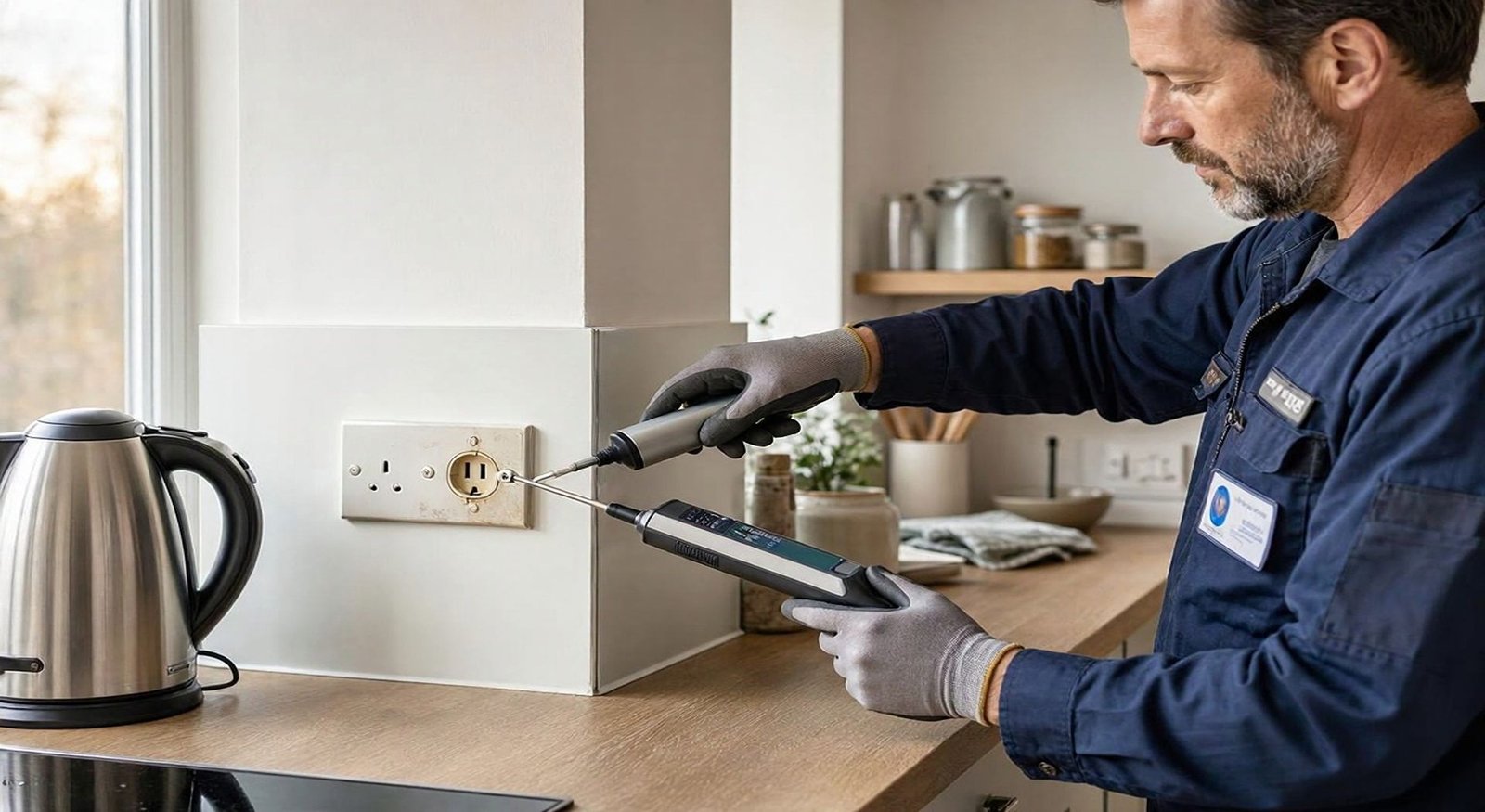
You walk past the plug socket by the kettle and catch it — a faint, acrid smell, like hot plastic or singed hair. You put your hand near it and the faceplate is warm. Or maybe you saw a blue flash when you switched something on, and now you’re not sure whether to ignore it or call someone.
Here’s the honest answer: a burning smell from a socket, a switch that’s hot to the touch, or a spark that came from inside the wall rather than the plug isn’t one of those “keep an eye on it” problems. It’s the moment before something worse. The good news is that most of these incidents are caught early enough to fix — if you know what you’re looking at and who to call.
This guide covers what those symptoms actually mean, what to do in the first five minutes, and why an emergency electrician is the right call rather than a general handyman with a screwdriver.
Why a Burning Smell From a Socket Is Never “Just a Smell”
That smell is usually overheated plastic insulation. Behind the faceplate, the copper conductor has been getting hotter than it should, and the PVC around it is starting to break down. Electricians often describe it as a fishy or hot-plastic odour — and once you’ve smelled it on a job, you don’t forget it.
There are three things that cause it, and none of them fix themselves:
Loose connection: the quiet culprit
A terminal screw that has worked loose over years of thermal cycling creates resistance. Resistance creates heat. Heat carbonises the plastic and eventually the wire itself. A loose connection is probably the single most common cause of a burning smell from socket outlets, and it can sit there smouldering for months before anything visible happens. The smell is your only warning.
Overload: too much demand on one circuit
An extension lead feeding a heater, a kettle, a tumble dryer and a charging brick is not a circuit. It’s a queue of appliances all drawing current through a socket rated for a fraction of that load. Over time the contacts inside the socket heat up, the plastic discolours, and the whole assembly starts to cook. In Dubai villas, this is often worse in summer when portable AC units get added to already-loaded circuits.
Arcing: the one that sparks
Arcing is electricity jumping across a gap instead of flowing through a solid contact. It happens at degraded terminals, corroded contacts, or where a plug has been pushed in and out so many times the internal springs have lost tension. Arcing produces intense localised heat — hot enough to melt a socket faceplate and ignite dust or insulation behind it. When you see a spark at the socket, this is usually what you’re seeing.
Socket Sparking, a Hot Switch, or a Smell from the DB Panel: What Each One Tells You
Not every symptom carries the same urgency, but they all point in the same direction.
Socket sparking
A small spark when you plug something in can sometimes be a harmless static discharge. A spark that comes from inside the socket, or happens while an appliance is already running, is arcing. If the socket face is blackened, cracked, or smells of burning, treat it as an emergency and stop using that outlet immediately — don’t unplug and re-plug to “test” it.
Hot switch
Light switches and socket switches should be barely above room temperature. If a switch is noticeably warm, or hot enough that you pull your hand away, the contacts inside are overheating. In older Mayfair townhouses, this often shows up on circuits that were designed for incandescent lighting and are now carrying LED drivers and dimmers that were never part of the original load calculation.
Smell of burning from the DB panel
This one is more serious than a single socket. The distribution board — the consumer unit, the breaker panel — is where all the circuits meet. A burning smell there suggests a loose main terminal, a failing breaker, or arcing on the busbar. It can affect every circuit in the property, and it is not something to investigate yourself. Isolate what you can safely reach and call an emergency electrician. In Dubai, a burning smell at the DB board is routinely treated as a same-day urgent call-out; in London, the advice is identical — isolate and call.
- Faint burning smell, no visible damage — What it usually means: loose connection or early overheating. Urgency: same day — do not ignore
- Socket faceplate warm or discoloured — What it usually means: overload or failing contacts. Urgency: isolate circuit, call now
- Spark from inside the socket — What it usually means: arcing at terminals. Urgency: emergency — stop using the outlet
- Burning smell at the DB panel — What it usually means: main terminal, breaker, or busbar fault. Urgency: emergency — isolate and evacuate if smoke appears
- Smoke or visible flames — What it usually means: active fire. Urgency: leave the property and call emergency services
What to Do If a Socket Is Hot — the First Five Minutes
Do this instead:
- Isolate the circuit at the consumer unit. If you know which breaker feeds that socket, switch it off. If you don’t know, switch off the main switch — it’s better to lose power for ten minutes than to lose the house.
- Leave the plug where it is until the circuit is dead. Once the power is off, you can remove it safely.
- Don’t spray anything — no air freshener, no “electrical cleaner”, no water. Aerosols near an arcing contact are a genuine fire risk.
- Feel the wall around the socket with the back of your hand. If the plaster is warm, heat is spreading behind the faceplate. That moves the situation from “urgent” to “call now”.
- If you see smoke or flames, leave the property and call the emergency services first. In Dubai, that’s Civil Defence on 997; in London, 999.
Once the power is off and the immediate risk is contained, the next step is getting someone qualified to open the socket and look behind it. That’s not a job for a general handyman, and it’s definitely not a job for a YouTube tutorial.
Burning smell, hot socket or sparking switch?
Isolate the circuit if it is safe to do so, then contact MAINTAINED’s emergency electrical team.
Why This Needs an Emergency Electrician, Not a General Repair
A burning smell or a sparking socket sits at the intersection of two trades that people often confuse. A multi-skilled handyman can change a faceplate, tighten a visible screw, and make something look fine. What they cannot do — legally or safely — is diagnose why the terminal overheated in the first place, test the circuit under load, or certify that the repair is sound.
An emergency electrician arrives with test equipment: a loop impedance tester, an insulation resistance tester, a thermal camera in serious cases. They can tell whether the damage is confined to one accessory or whether the cable behind it has been compromised along its run. That distinction matters enormously. A melted socket replaced without investigating the cable is a fire waiting for a second chance.
There’s also the insurance question. If a fire starts at a socket that was “fixed” by an unqualified person, most policies will treat that as a breach of the installation regulations. In London, that means a repair that doesn’t meet BS 7671; in Dubai, it means work outside the scope of a licensed contractor. Either way, the cheap repair becomes the expensive claim.
When the electrician does open the wall, there’s a reasonable chance the repair will need making good afterwards — plaster, paint, possibly a section of drylining if the heat has travelled. That’s where our drylining and plaster repair team comes in, so you’re not left with a working socket and a hole in the wall.
Electrical Fire Risk in Dubai Villas and London Townhouses: Different Buildings, Same Warning Signs
The underlying physics is the same everywhere, but the buildings change which failures are most likely.
Dubai villas: heat, load and summer
In a Dubai villa, the electrical load in July is nothing like the load in January. Air conditioning runs continuously, pool pumps cycle more often, and the general wear on every terminal in the DB panel is accelerated by ambient heat. A loose connection that would smoulder quietly in a temperate climate can arc much sooner here. If you’ve noticed a burning smell from a socket or a warm switch in a villa in Jumeirah, JGE or JBR, the summer load is often the trigger that pushed a marginal connection over the edge.
It’s also worth saying that the DB panel itself deserves attention. Many villa installations have had circuits added over the years — a garden office, an outdoor kitchen, a pool heater — without the panel being upgraded to match. That’s a slow-motion overload, and the burning smell at the panel is how it announces itself.
Mayfair and London period homes: old wiring, new demand
In a Mayfair townhouse, the risk profile is different. The wiring may be decades old, the consumer unit may have been updated in stages, and the original circuits were never designed for the number of devices a modern household runs. A hot switch in a period property often traces back to a lighting circuit carrying a load it was never sized for, or to a socket circuit that has been extended one too many times.
Older accessories also degrade in a specific way. The plastic behind a faceplate becomes brittle, the terminal screws lose torque, and the whole assembly becomes more sensitive to heat. A burning smell in a period home is worth taking seriously precisely because the margin for error is smaller.
If the socket that’s overheating is outdoors — a garden socket, a pool equipment supply, a gate motor — the fault may be weather ingress rather than load. That’s a different diagnosis, and it’s one we cover under garden and outdoor maintenance when irrigation or exterior power is involved.
What the Electrician Will Actually Do
Understanding the process makes the call less stressful. A proper emergency response isn’t a man with a screwdriver and a roll of tape.
Step 1: make safe and isolate
The first job is to confirm the circuit is dead and that no other circuit is affected. If the smell is at the DB panel, the electrician will isolate at the main switch and test for presence of voltage before touching anything.
Step 2: open and inspect
The socket or panel cover comes off, and the damage is assessed. Discoloured terminals, carbon tracking, melted insulation, a loose screw — each tells a story about how long the fault has been developing.
Step 3: test the circuit, not just the accessory
This is the part that separates a proper repair from a cosmetic one. Insulation resistance and continuity tests reveal whether the cable behind the socket has been damaged by heat. If it has, replacing the socket alone is pointless — the compromised section of cable needs to be cut back and re-terminated, or in worse cases, the run needs partial rewiring.
Step 4: repair, replace and certify
Once the cause is confirmed, the repair is straightforward: new accessory, new terminals, correct torque, and a test certificate. In London, that means a minor works certificate; in Dubai, a report that satisfies the licensing authority. If the damage extends into the wall, the making good is scheduled separately so the electrician isn’t trying to plaster while the circuit is still being tested.
One more thing worth mentioning: if the fault has been caused by an appliance rather than the wiring, the electrician will tell you. A kettle with a failing element or a charger with a damaged lead can overheat a healthy socket. In that case, the socket gets replaced, but the appliance is the thing that needs retiring. If the appliance is a fixed one — a water heater, a pool pump — the repair may fall under plumbing and water system work rather than general electrical.
How to Choose an Emergency Electrician in a Hurry
When you’re standing in a hallway with a burning smell and a phone in your hand, you don’t have time to read a hundred reviews. A few filters will get you to the right person quickly.
- Ask if they’re licensed for emergency call-out in your city. In Dubai, that means a contractor licensed by the relevant authority; in London, NICEIC or equivalent registration. A genuine emergency electrician will answer that question without hesitation.
- Describe the symptom precisely. “Burning smell from a socket in the kitchen, faceplate warm, no smoke” gets a different response than “something smells hot somewhere”. The more specific you are, the faster they can prioritise.
- Ask what they’ll do first over the phone. A good electrician will tell you to isolate the circuit before they arrive, and will ask whether anyone is vulnerable in the property.
- Confirm they carry test equipment. If the answer is “I’ll bring a multimeter”, that’s not enough for this kind of fault. You want insulation resistance and loop testing capability.
- Don’t accept “I’ll come tomorrow”. A burning smell is a same-day call-out, full stop. If a company can’t attend, call the next one. Our emergency electrical team covers Dubai, Abu Dhabi, London and Mayfair, and we treat burning smells and sparking sockets as priority work.
If you’re not sure whether the fault is electrical or something else — a burning smell can occasionally come from an overheating pump, a blocked AC drain, or a failing water heater — say so when you call. We’d rather send the right trade first time, and our HVAC and cooling team works alongside the electrical team on exactly these cross-over calls.
When to Call, and What to Say
The threshold is simpler than people think. If you can smell burning near anything electrical, or if a socket or switch is hot, or if you’ve seen a spark come from inside a fitting rather than from the plug — that’s the call. You don’t need to diagnose it first, and you don’t need to wait for visible damage.
Call the emergency electrician, tell them what you can smell and see, and isolate the circuit if you can reach the breaker safely. We cover Dubai, Abu Dhabi, London and Mayfair, and a burning smell from a socket or a hot switch is treated as priority work — because by the time it’s visible, it’s usually been developing for a while.
Frequently Asked Questions
Is a burning smell from a socket always an emergency?
Not always a fire, but always urgent. The smell means something is overheating, and overheating is the mechanism behind most electrical fires. The correct response is to isolate the circuit and have it inspected the same day. Waiting to see if it gets worse is how small faults become insurance claims.
Can I just replace the socket myself?
You can physically replace a socket. What you can’t do without test equipment is confirm that the cable behind it hasn’t been damaged, that the circuit isn’t carrying an overload, and that the new accessory is correctly terminated. A socket swap that hides a damaged cable is worse than no repair at all, because it removes the warning sign.
What if only the plug is hot, not the socket?
A hot plug usually points to a problem in the plug itself — a loose fuse clip, a damaged lead, or an appliance drawing more current than the plug is rated for. Unplug it, don’t reuse it, and have the appliance checked. If a second plug in the same socket also gets hot, the fault is in the socket, not the plug.
How quickly can an emergency electrician get to a villa in Dubai or a flat in Mayfair?
For genuine burning-smell or sparking-socket calls, most reputable teams aim for same-day attendance, often within a few hours. In Dubai, 24/7 call-outs are standard for licensed emergency electricians. In central London, response times depend on traffic and access, but a priority call is usually attended the same day. The important thing is to isolate the circuit while you wait — that buys time safely.
What if the burning smell comes back after a repair?
Then the original diagnosis missed something. A correctly repaired circuit should not smell of burning again. If it does, stop using it and call the same electrician back — a repeat smell usually means the fault is upstream of the accessory that was replaced, often in a junction box or along the cable run. Don’t pay twice for the same problem; a good firm will return to finish the diagnosis.
Need an emergency electrician?
We cover Dubai, Abu Dhabi, London and Mayfair. A burning smell from a socket or a hot switch is treated as priority work.