

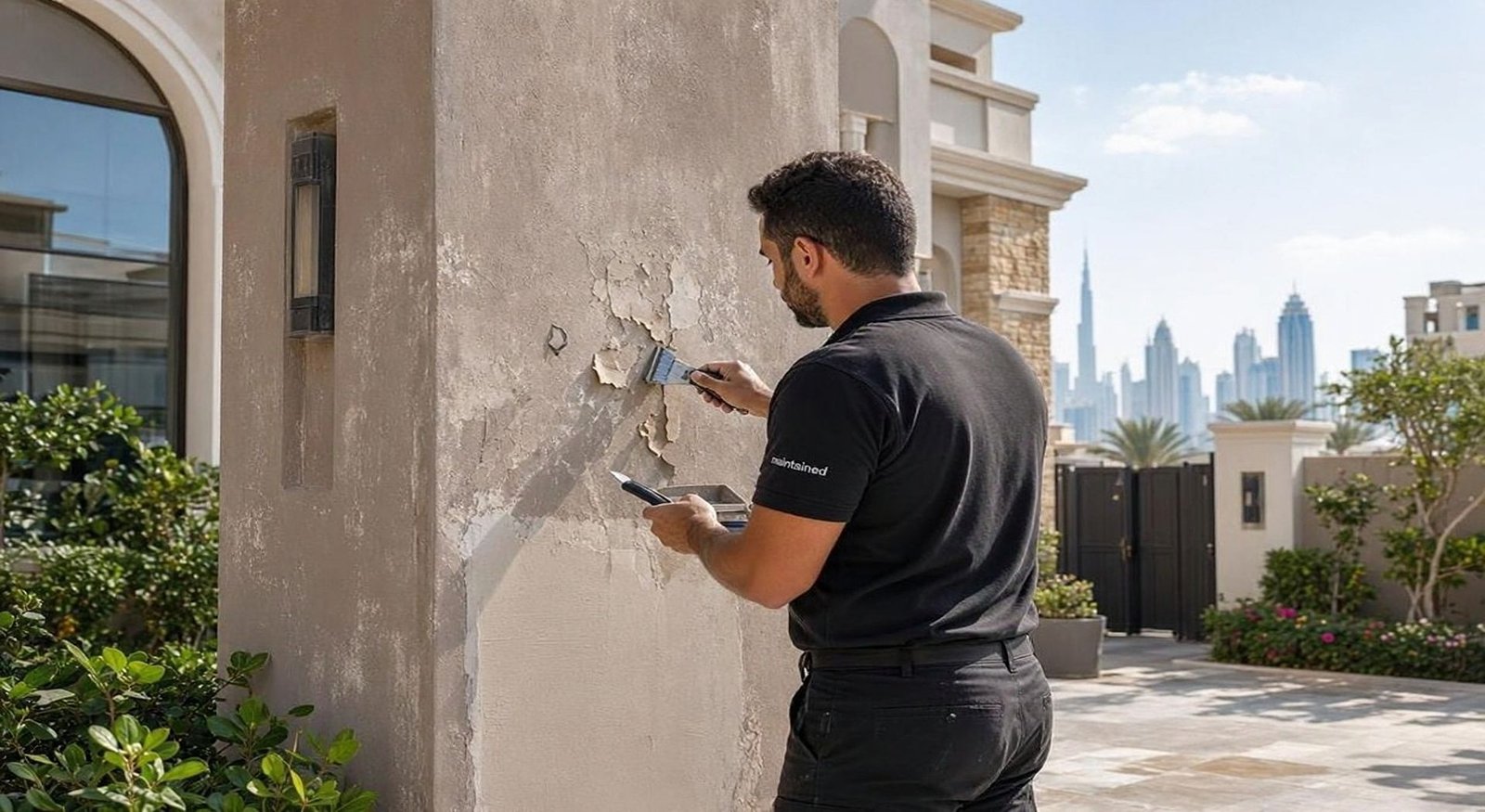
You notice it on the boundary wall first. A patch of paint that’s lifted away from the render, curling at the edges. Then the garage side of the villa starts fading into a chalky, washed-out version of the colour you chose. By the time the front elevation looks tired, the paint has usually been failing for two summers.
Exterior paint peeling in Dubai isn’t a cosmetic problem that can wait. Once paint lifts, water gets behind it, and the render underneath starts to go. This guide covers why villa exteriors fail here, what the three common symptoms actually mean, and what the right paint system is for this climate.
Why Villa Exterior Paint Fails Faster in Dubai
Four things work against paint here, and most failures come from a combination rather than a single cause.
- UV — the biggest one. Dubai gets around 3,500 hours of sunshine a year, and UV breaks down the resin in exterior paint. That’s what produces chalking — the fine powdery layer that comes off on your hand when you rub the wall. Chalking isn’t just cosmetic; it means the binder has broken down and the paint no longer protects what’s underneath.
- Heat cycling — the second. A south-facing wall can hit 60–70°C on the surface in summer and drop to 20°C at night. That expansion and contraction puts stress on the paint film every single day, and eventually the film loses adhesion at the weakest point.
- Humidity and salt air — the third, particularly on the coast. Moisture in the wall pushes outward, and paint that isn’t fully adhered will lift. Salt accelerates the process near the shoreline.
- Dust and sand — the fourth. Fine particles settle on the surface, hold moisture against it, and interfere with adhesion if the wall isn’t properly cleaned before painting.
Peeling, Fading or Chalking: What Each One Tells You
The symptom tells you what’s going wrong, and the fix is different in each case.
Exterior paint peeling off walls
Peeling is an adhesion failure. The paint has let go of the surface, and there are only a few reasons that happens.
Moisture is the most common. Water getting behind the paint — from a leaking gutter, a hairline crack in the render, or rising damp at the base of the wall — pushes the film away. Paint bubbling outside is the early stage of this; the bubble is water vapour trying to escape.
The second is inadequate preparation. If the wall was dusty, or painted over a chalky surface, or the primer wasn’t suited to the substrate, the paint will lift within a year or two. This is the most common cause we see on villas that were painted quickly at handover.
The third is incompatible coats. Putting a modern acrylic over an old oil-based or distemper coat without the right primer creates a film that looks fine for months and then peels in sheets.
Why is my villa paint fading?
Fading is pigment breakdown, driven mostly by UV. Reds, yellows and deep blues fade fastest because their pigments are less UV-stable. A villa painted in a strong colour on a west-facing wall will show noticeable fading within three to four years, while a light neutral on a shaded side can hold for twice as long.
Fading isn’t necessarily a sign the paint has failed — it can still be protecting the wall. But if the surface has also gone chalky or started to peel, the protection is gone and repainting is due.
Chalking and sun damage paint
Chalking is the powdery residue that comes off on your hand. It’s the binder breaking down under UV, and it’s a normal part of paint ageing — the question is how fast it’s happening. On a good exterior paint in Dubai, light chalking after four to five years is expected. Heavy chalking within two years means either the paint was low-grade or it’s been over-thinned.
Best Exterior Paint for Dubai Heat
Elastomeric coatings
Elastomeric paint is the best choice for villa exteriors in Dubai. It forms a thicker, rubber-like film that bridges hairline cracks in the render and moves with the wall as it expands and contracts. It’s more expensive than standard exterior emulsion, but on a villa with any cracking or movement, it lasts noticeably longer. It also handles UV better than most standard exterior paints, which means slower chalking and slower fading.
Textured paint and rubber paint
Textured paint Dubai villas often use is a good option for boundary walls and elevations where the render is uneven — the texture hides imperfections and adds a bit of thickness to the film. Rubber paint is similar in concept to elastomeric, and it’s a reasonable choice for walls that have shown movement. Both need proper priming, and both are harder to apply cleanly than a flat emulsion, so the applicator matters.
Exterior emulsion and the value trap
Standard exterior emulsion is the cheapest option, and it’s what most value exterior painting quotes will be based on. It works fine on a sound, well-prepared wall that’s due for a refresh. It doesn’t work on a wall with movement, cracking or a history of peeling — it’ll fail in the same places, faster.
Where owners often get caught is choosing a recognised brand name without checking the specific product. Behr paint UAE, National paint exterior, and the major Gulf brands all make both budget and premium exterior lines, and the difference between them is significant. The brand on the tin matters less than the product tier within that brand.
Quick reference: symptom, cause and approach
- Peeling in sheets — likely cause: poor preparation or incompatible coats. Approach: strip, prime, repaint with a compatible system.
- Bubbling or blistering — likely cause: moisture behind the paint. Approach: find and fix the water source first.
- Fading on one elevation — likely cause: UV breakdown of pigment. Approach: repaint with a UV-stable exterior system.
- Powdery chalky surface — likely cause: binder breakdown under UV. Approach: wash, stabilising primer, then topcoat.
- Hairline cracks in render — likely cause: thermal movement. Approach: elastomeric coating to bridge movement.
How Often to Repaint a Villa in Dubai
There’s no fixed number, but realistic ranges help plan.
A villa with a quality elastomeric system, properly applied, can go six to eight years before it needs a full repaint. A standard exterior emulsion on a well-prepared wall is more like four to five years. A cheap job on poor preparation can look tired within two.
The right answer depends on the wall, not the calendar. Walking the elevations once a year and looking for the early signs — chalking on the hand, a bubble near a downpipe, a hairline crack that’s opened — tells you more than a schedule. If the surface is sound and the colour is still acceptable, you have time. If the paint has started to lift anywhere, you don’t.
If the render underneath has cracked or gone soft, the paint isn’t the only problem. Our plaster and render repair team in Dubai handles the substrate side before the decorating team starts, so the new paint is going onto a sound wall rather than hiding a problem.
Villa paint peeling or fading?
Contact MAINTAINED now. We inspect the elevations, work out whether it’s a paint, moisture or render problem, and tell you honestly before anyone opens a tin.
Paint Restoration and Surface Prep
Most exterior paint problems in villas are really preparation problems. Paint restoration isn’t a different product — it’s a different process:
- The wall is washed to remove dust, salt and chalking.
- Loose and flaking paint is scraped back to a sound edge.
- Any cracks in the render are raked out and filled.
- Bare patches are primed with a product suited to the substrate.
- Then the topcoat goes on.
Skipping any of these steps is what causes the peeling that follows.
On coastal villas, salt removal is a step in itself, and it’s often the one skipped. A wall that still has salt on it will fail again within a couple of seasons, no matter what paint goes on top. Our exterior cleaning and facade washing team in Dubai handles the prep wash before the decorators start.
If the villa also needs small repairs around the exterior — a downpipe re-clipped, a garden light refitted, an outdoor socket re-sealed after the paintwork — those are usually best done in the same visit rather than left for later. Our multi-skilled repair team in Dubai covers those so the exterior is finished properly.
Choosing Exterior Painting Services in Dubai
Quotes for exterior painting in Dubai vary widely, and the cheapest is rarely the best value once you count how soon it needs doing again.
Ask what preparation is included. A quote that just says “paint exterior” and doesn’t specify washing, scraping and priming is a quote for a topcoat over whatever’s there. Ask what product is being specified — brand and tier, not just “exterior paint”. Ask whether the render will be inspected for cracks and how they’ll be dealt with. Ask whether scaffolding or access equipment is included, especially on a two-storey villa with a complex elevation.
The other filter is whether the contractor will tell you not to paint yet. If the render is still drying, or the wall has an unresolved leak, painting now wastes money. A good decorator says so instead of taking the job.
Book an exterior paint survey in Dubai and get an honest assessment before the next repaint. We cover Dubai-wide, and if the peeling turns out to be a moisture problem rather than a paint problem, we’ll tell you before anyone opens a tin.
Frequently Asked Questions
Why is my villa exterior paint peeling in Dubai?
Almost always one of three things: moisture getting behind the paint, inadequate preparation before the previous coat, or an incompatible product over an old one. Paint doesn’t fail on its own — something underneath it is wrong. A survey identifies which of the three is happening before repainting.
What is the best exterior paint for Dubai heat?
An elastomeric coating is the best all-round choice for villa exteriors, because it bridges hairline cracks and handles UV better than standard emulsion. On a sound wall with no movement, a premium exterior emulsion is fine. The product tier matters more than the brand on the tin.
How often should a villa exterior be repainted in Dubai?
Six to eight years for a quality elastomeric system properly applied, four to five years for standard exterior emulsion. A cheap job on poor preparation can look tired within two. Checking the elevations once a year catches problems earlier than a fixed schedule.
Can I just paint over peeling walls?
No. Painting over lifting paint traps the problem and the new coat peels with the old one. Loose paint has to be removed, the surface prepared and primed, and the cause of the peeling addressed — usually moisture or poor adhesion — before any topcoat goes on.
Exterior paint surveys in Dubai
We inspect the elevations and the render, and tell you honestly whether you need a repaint or a moisture fix first. We cover Dubai-wide.