

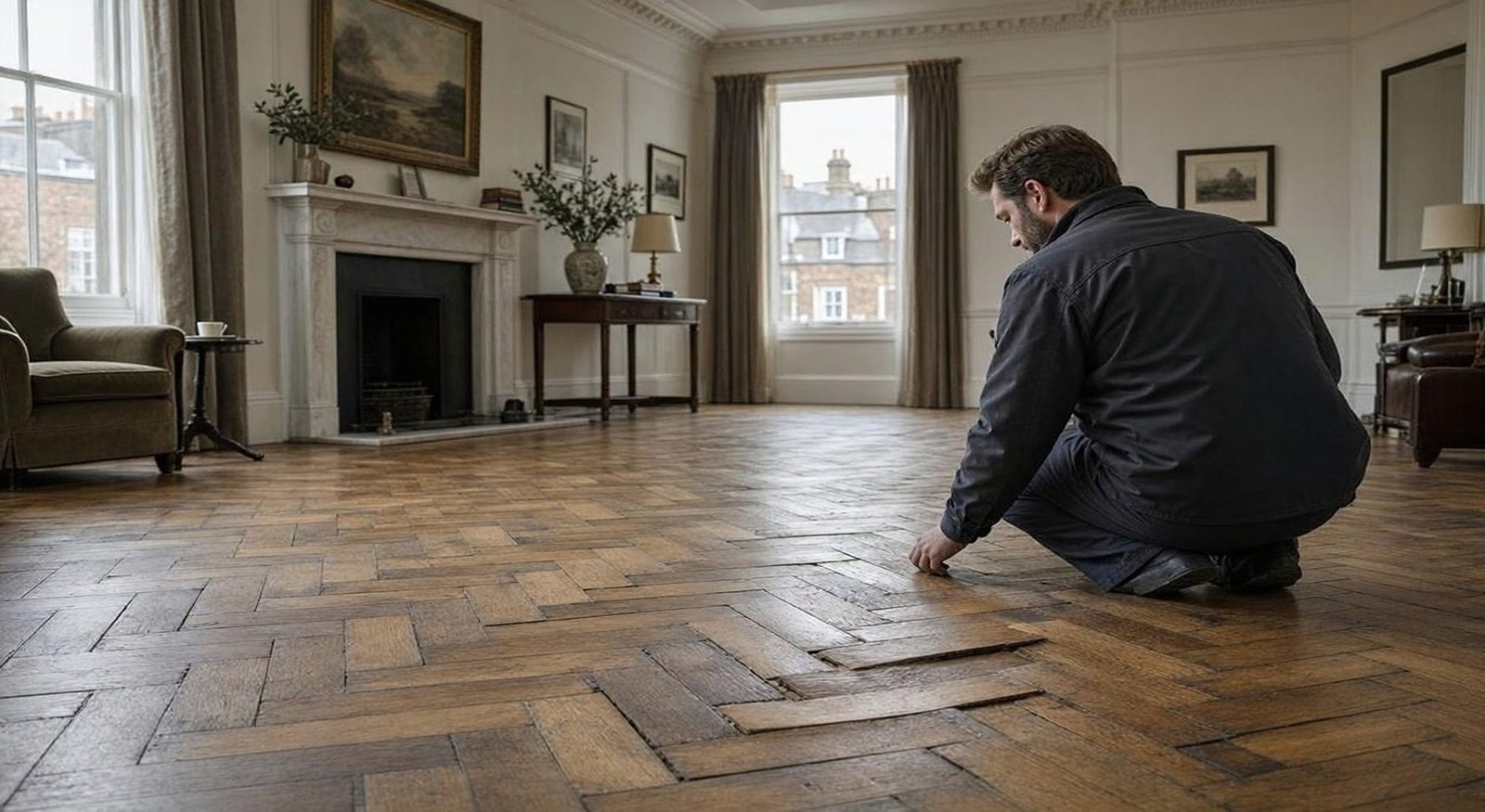
There’s a particular sound a parquet floor makes when it’s starting to go. You walk across the room and one block shifts underfoot — a small movement, but you feel it. Two winters later, there’s a ridge along the herringbone pattern where the blocks have lifted, and a hollow crunch every time you cross the same spot.
Most of the parquet floors we survey in Mayfair and the surrounding streets are 90 to 130 years old. Some have been sanded so many times the wear layer is down to a few millimetres. Others were covered by carpet for decades and look perfect until you lift the underlay and find the blocks beneath are loose, damp or stained. The good news is that parquet is remarkably repairable — far more so than modern engineered flooring. The question isn’t usually “can it be saved”, it’s “which parts are worth saving and which need replacing”.
Why Parquet Floor Problems Are So Common in London Townhouses
A parquet floor in a Victorian house was laid to last, but it was laid for a different kind of life. No central heating cycling on and off, no washing machine in the kitchen, no underfloor heating pipes running through the joists beneath it.
What’s actually under parquet flooring
In most period townhouses, the parquet blocks sit on a bitumen or felt layer over timber joists or a solid subfloor. That bitumen was fine when it was applied, but it becomes brittle with age. Once it cracks, the blocks lose their bedding and start to move. If you’ve ever lifted a loose block and found black, flaky adhesive underneath, that’s the original bitumen failing after a century. Where a modern heating system has been retrofitted beneath — which we see often in renovated Mayfair homes — the interaction between the heat and the old adhesive is worth understanding before any repair. Our HVAC and underfloor heating team can confirm whether the system is contributing to the problem.
Loose and blown parquet blocks
A single loose block is a small repair. “Blown” parquet — where a whole area has lifted because the adhesive has failed across a section — is a different job. Blown flooring usually shows as a hollow sound when tapped, or a visible rise along a line of blocks. Left alone, it spreads: the movement crushes the tongue-and-groove edges, and once those are gone, the blocks can’t be re-fixed as they were.
Water Damaged Parquet Floor: The Most Expensive Kind of Damage
If there’s one thing that turns a fixable floor into a replacement job, it’s water. A slow leak under a sink, a radiator valve that’s been weeping for months, or a single flooding event from an upstairs bathroom — all of them cause the same chain reaction. The blocks swell, the adhesive fails, and the timber starts to cup or crown.
The frustrating part is that water damage often hides. A townhouse in Mayfair with a period kitchen might have its parquet under a modern floor covering, and the first sign is a soft spot or a musty smell. By the time it’s visible, the damage usually covers a larger area than it appears. The source matters as much as the floor itself, which is why we always recommend finding the leak before laying a single new block — our plumbing team handles leak detection and repairs, and it’s genuinely cheaper to fix the cause first than to repair the same floor twice.
Once the source is fixed, the question becomes whether the affected blocks can be dried, sanded and re-fixed, or whether they need replacing. Cupped blocks can sometimes be sanded flat if there’s enough thickness left. Crowned blocks, or ones that have delaminated, usually can’t.
Parquet Floor Bulging, Coming Up, and Loose Tiles: What Each One Tells You
The three symptoms look similar to an untrained eye but point to different problems.
- Bulging across a large area is almost always moisture — either from below (a damp subfloor) or from a leak above. It can also follow a flood or a slow radiator leak that’s been absorbed into the timber.
- Coming up at the edges, usually near a doorway or against a wall, is more often adhesive failure than moisture. That’s the blown parquet pattern described above, and it’s the more straightforward of the three to fix.
- Loose individual tiles — a block that rocks when you step on it — can be a single failed bond, or the first sign of a wider problem. Worth lifting and checking before assuming it’s a small job.
- Single rocking block — Most likely cause: failed adhesive at one joint. Usually fixable? Yes — straightforward re-fix
- Hollow sound across a section — Most likely cause: blown parquet, adhesive failure. Usually fixable? Yes, if tongue-and-groove edges are intact
- Ridge or rise along the floor — Most likely cause: moisture — leak or damp subfloor. Usually fixable? Depends on how much timber has swelled
- Cupping or crowning — Most likely cause: water damage, often long-standing. Usually fixable? Partial — some blocks will need replacing
Scratched Parquet and Gaps: What You Can Fix Without Lifting a Block
Not every parquet floor problem is structural. Scratches, small gaps between blocks, and a tired finish are cosmetic issues — and they’re the ones where sanding and refinishing makes the biggest visible difference.
Fine scratches in the finish can often be dealt with by a light sand and re-coat, without a full resanding. Deeper scratches that go into the timber itself need the floor sanded back to bare wood and refinished. Gaps between blocks are usually caused by seasonal movement, and in most period floors they’re part of the character. If they’re wide enough to catch a heel, they can be filled with a matching filler — but the filler has to be colour-matched to the surrounding blocks, or it stands out worse than the gap.
What’s not worth attempting is spot-sanding. A patch of floor sanded and refinished without blending into the surrounding area will show under any light, and on a herringbone pattern it’s very obvious. Either the whole room is resanded or the damage is accepted as part of the floor’s age.
Loose, lifting or water-damaged parquet?
Contact MAINTAINED to arrange a floor assessment before the damage spreads.
Can You Restore Parquet Flooring, or Is Replacement the Only Option?
This is the question most owners ask, and the honest answer depends on three things.
- Thickness. A parquet block starts at around 10mm wear layer. If it’s been sanded four or five times over its life, there may be only 3–4mm left. That’s enough for a light sand, but not for aggressive flattening. If the blocks are cupped and the only fix is to sand them flat, thin blocks will fail.
- Coverage of the damage. A floor with 10% damaged blocks is a repair. A floor where 40% is blown, cupped or stained is usually a partial replacement — lift the whole affected area, replace the blocks with reclaimed stock, and blend the new into the old.
- Matching stock. Herringbone blocks in period dimensions aren’t sitting on a shelf. Reclaimed parquet is available, but matching species, width and thickness takes time and costs more than new. In most Mayfair townhouses we’re matching old oak to reclaimed oak, or accepting a slight difference in tone that becomes invisible after finishing.
Where the underlying subfloor has failed — joists rotted, a concrete slab breaking up — the floor has to come up regardless of the parquet’s condition. That’s when the job expands, and it’s also when the making-good matters. Our drylining and plaster team handles any skirting, subfloor and wall repairs so the floor can go back down onto a sound base.
Parquet Floor Repair Near Me: What to Check Before You Book
Anyone can turn up with a sander and a drum of varnish. Fewer can lift a section of blown herringbone, salvage the intact blocks, re-fix them and blend a repair so it’s invisible from standing height. A few things worth asking:
- Ask to see a herringbone repair they’ve done — not just a full sand and finish. The two are different skills.
- Confirm they can source reclaimed stock in the right dimensions. If the answer is “we’ll use new and it’ll match”, ask to see an example.
- Check how they deal with bitumen. Old bitumen needs to be removed properly before new adhesive, or the repair will fail within a couple of years.
- Ask about dust control. Sanding a parquet floor in a furnished townhouse without extraction is a week of cleaning afterwards.
Parquet Restoration Cost in London: What Actually Drives the Number
Restoration cost is driven almost entirely by how much of the floor has to be lifted versus simply sanded. A full sand and refinish of a room in a Mayfair townhouse typically starts in the low thousands. A repair that involves lifting a section, replacing 20–30 blocks with reclaimed stock, re-fixing and blending comes in significantly higher — often two to three times the cost of a straightforward sand and finish, because the labour and the matching take far longer.
Water damage that’s spread under a large area of flooring is the expensive scenario. If the subfloor also needs attention — new ply, joist repairs, damp proofing — the floor becomes one part of a bigger job. It’s always worth having an assessment before committing to a number, because the difference between “repair” and “replace” is often only visible once the floor is opened.
If the room also needs redecorating after the work — skirting repainted, walls freshened — our decorating team can handle that in the same visit so the room is finished properly rather than left half-done.
Damaged Flooring in a Rental, and the Fake Parquet Problem
Two situations we see often and both are worth mentioning.
In a rental, the tenant and landlord need to agree on what’s damage and what’s fair wear. Water damage from a tenant’s plant pot is different from a floor that was already lifting before the tenancy started. Photographs at check-in, and a written note of any existing damage, save arguments later. If you’re a landlord with damaged flooring in a rental, an assessment before the next tenancy is usually cheaper than discovering it mid-term — and the small fixes between tenancies often sit comfortably under our handyman and multi-skilled team.
The other situation is fake parquet — laminate or engineered planks printed to look like herringbone. Under a carpet, it can look convincing at first glance. It can’t be sanded, it can’t be repaired the same way, and if it’s failing the answer is usually replacement rather than restoration. Worth knowing before you budget for a restoration that isn’t possible.
When to Book a Floor Assessment
If you’ve got a single loose block, book an assessment rather than a repair. A proper look will tell you whether it’s an isolated failure or the start of something larger, and it’s a much cheaper conversation than waiting for the floor to blow across a room.
If the floor is water damaged, book as soon as the leak is fixed. Every week the timber stays wet increases the chance that more blocks will have to be replaced rather than salvaged.
And if the floor has been hidden under carpet for years, book before you plan the room around it. What’s underneath might be beautiful, might be a repair job, or might be a floor that needs replacing entirely — but you won’t know until someone lifts a corner and looks.
Book a floor assessment and find out what you’re actually standing on. We cover Mayfair and central London, and if the assessment turns up something unexpected — a leak, a failing subfloor, a floor that’s beyond saving — we’ll tell you straight rather than sell you a restoration that won’t last.
Frequently Asked Questions
Can damaged parquet flooring be repaired, or does it always need replacing?
Most damaged parquet can be repaired. Single loose blocks, small blown sections and scratched surfaces are all fixable. Replacement becomes the answer when the damage covers a large area, the blocks are too thin to sand, or the subfloor underneath has failed. An assessment is the only way to know for certain.
How do I fix parquet floor gaps?
Small gaps are usually seasonal movement and can be left alone. Larger gaps can be filled with a colour-matched filler, but the filler needs to be matched to the surrounding timber or it’s more visible than the gap. Gaps that keep reopening after filling usually indicate movement in the subfloor, and that’s the real problem to address.
Can water damaged parquet floor be saved?
Sometimes. If the water damage is recent and the blocks haven’t delaminated, drying and re-fixing can work. Once the blocks have cupped badly or the adhesive has failed across a section, those blocks need replacing. The earlier it’s assessed after the leak is fixed, the better the odds of saving more of the original floor.
How much does it cost to repair water damaged parquet floor in London?
It depends on how much of the floor is affected and whether the subfloor needs work. A small area of water damage — a few blocks lifted and replaced — sits at the lower end. Damage that’s spread under a whole room, with subfloor repairs needed, can cost several times more. An assessment gives you a realistic range before any work starts.
Find out what you’re actually standing on
Book a floor assessment with MAINTAINED. We cover Mayfair and central London.